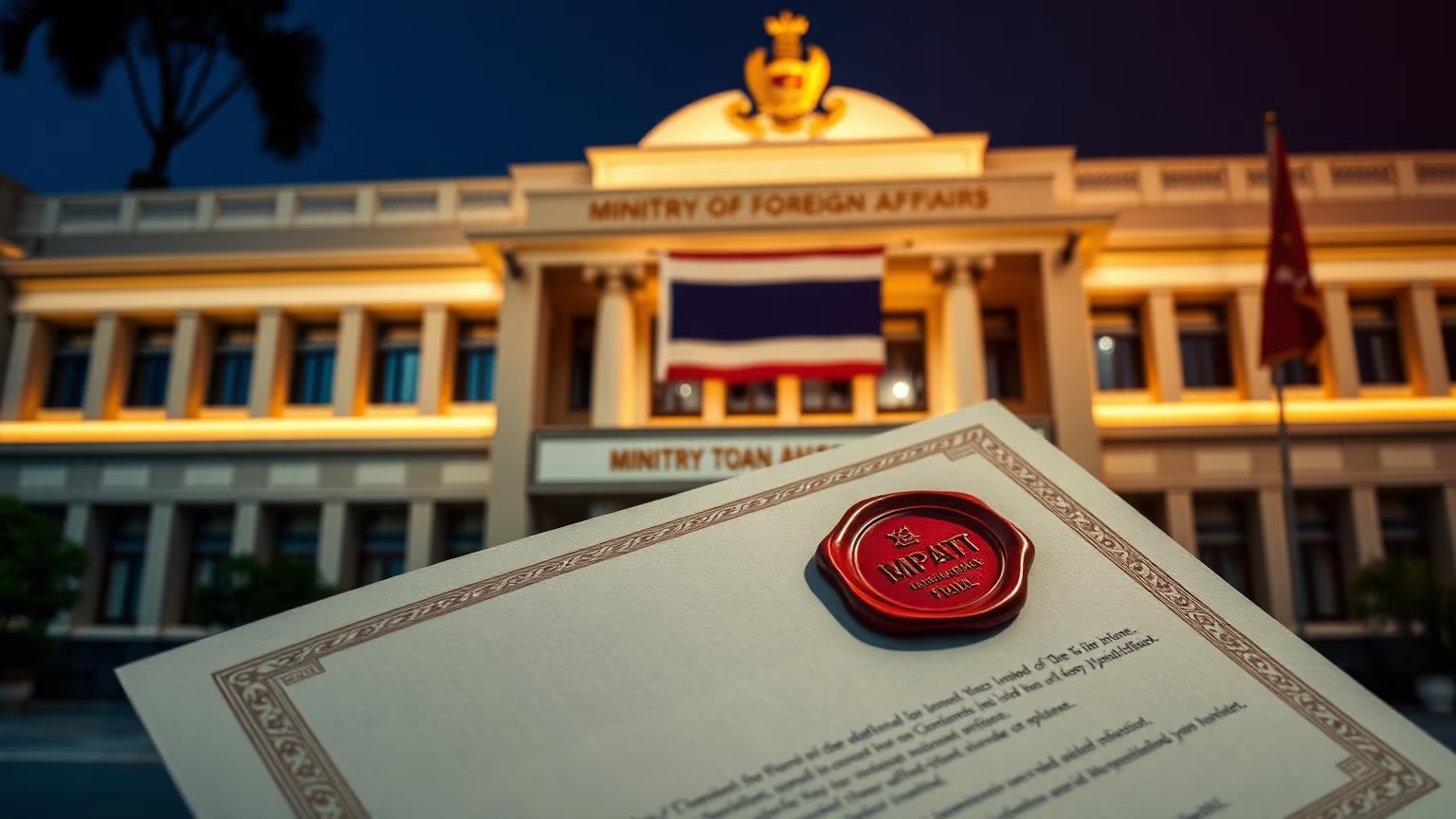
MFA legalization is processed at the Department of Legalisation (Chaeng Watthana). Standard turnaround is 3 working days; an express track is available.
重要ポイント
タイの公文書は原本、または発行機関が証明した写しが必要です
翻訳は原本と完全に一致していなければ受理されない場合があります
多くの国では、タイ側認証の後に提出先大使館の認証も求められます
手数料と日数は外務省領事局の告示に従います
手続の流れ(概要)
ステップ
実施主体
必要書類
所要目安
1. Obtain the original or certified copy of the Thai document
Issuing agency (district office, DOPA, etc.)
ID/passport + request form
approx. 1–5 working days
2. Translate the document exactly
Translator accepted by the Department of Consular Affairs
Original + passport copy (matching name spelling)
approx. 1–3 working days
3. File for legalization of the document and translation
Department of Consular Affairs, MFA
Original + translation + application form
approx. 2–5 working days (standard service)
4. Destination-embassy legalization where required
Real customer questions, answered by our attorneys
Selected from our knowledge base of 3,300+ real questions we have answered.
Do documents issued by government offices in Surat Thani–Koh Samui need a freshly certified copy before MFA/embassy legalisation (and Apostille from 28 February 2027)?
Consular / Apostille
Practitioner's view to "Do documents issued by government offices in Surat Thani–Koh Samui need a freshly certified copy before MFA/embassy legalisation (and Apostille from 28 February 2027)?" — Inbound chain for foreign documents used in Thailand: notarisation/Apostille in the country of origin → that country's embassy in Bangkok (if not an Apostille state) → Thai translation → MFA certification, after which DBD, district offices, Immigration and the Thai courts will accept the file. Thai consular legalisation is performed by the Legalization Division, Department of Consular Affairs, Ministry of Foreign Affairs, at Government Complex Chaeng Watthana (Building B), plus MRT Khlong Toei and regional counters. Door-to-door pickup in Bangkok and DHL dispatch worldwide — call 094-895-8999.
Process in brief: (1) check whether a parent authority must endorse the document first — a school, hospital or line department; (2) translate into the required language; (3) certify the translation; (4) complete the next certification layer; (5) submit within the validity window the destination accepts.
What to prepare: the original or a certified extract from the issuing authority, a copy of the holder's ID or passport, a power of attorney if someone files on your behalf, and the exact English spelling of every name as it appears in the passport.
Common pitfall: self-made or machine translations are usually refused — reviewers check the letterhead, the translator's certification wording, and whether every stamp on the original has been rendered.
Practitioner's tip: treat the destination authority's own published checklist as the final reference; country-specific rules change, and we will review that checklist with you before filing.
Living in Phuket, do I have to travel to Bangkok for MFA/embassy legalisation (and Apostille from 28 February 2027), or can documents be couriered both ways?
Consular / Apostille
Per the Legalization Division, Department of Consular Affairs (MFA Thailand) to "Living in Phuket, do I have to travel to Bangkok for MFA/embassy legalisation (and Apostille from 28 February 2027), or can documents be couriered both ways?" — Thai consular legalisation is performed by the Legalization Division, Department of Consular Affairs, Ministry of Foreign Affairs, at Government Complex Chaeng Watthana (Building B), plus MRT Khlong Toei and regional counters. Thailand deposited its instrument of accession to the Hague Apostille Convention on 30 June 2026, with entry into force for Thailand on 28 February 2027, so documents destined for member states now need a single Apostille from MFA — no destination-embassy step, except for states that objected to Thailand's accession. Send a photo of the document to LINE @Thainotary and we will quote the chain, cost and timeline before work begins.
Process in brief: (1) confirm whether the receiving body wants an Apostille or embassy legalisation; (2) obtain the certified original from the issuing authority; (3) translate through an accepted translator; (4) certify translation and signature; (5) keep high-resolution colour scans of every page before the file leaves Thailand.
What to prepare: the original or a certified extract from the issuing authority, a copy of the holder's ID or passport, a power of attorney if someone files on your behalf, and the exact English spelling of every name as it appears in the passport.
Common pitfall: states that objected to Thailand's accession to the Apostille Convention still require destination-embassy legalisation, so confirm the destination's position before starting.
Practitioner's tip: if the same document is needed by several authorities, produce all copies in one round — it saves time and keeps the certification format consistent across the sets.
What consular steps govern foreign marine life protection and sanctuary management deeds?
Consular / Apostille
Per the Legalization Division, Department of Consular Affairs (MFA Thailand) to "What consular steps govern foreign marine life protection and sanctuary management deeds?" — Thailand deposited its instrument of accession to the Hague Apostille Convention on 30 June 2026, with entry into force for Thailand on 28 February 2027, so documents destined for member states now need a single Apostille from MFA — no destination-embassy step, except for states that objected to Thailand's accession. You never need to attend Chaeng Watthana yourself — we file under a power of attorney, track the queue, and courier the sealed originals back by EMS or DHL worldwide. Free consultation on LINE @Thainotary or call 094-895-8999 (Mon–Sun 08:00–20:00 ICT).
Process in brief: (1) decide whether the destination requires an original or a certified true copy; (2) prepare a power of attorney if you cannot attend; (3) translate in the required format; (4) file and monitor the queue; (5) verify whether supporting documents are also required at destination.
What to prepare: the original, a signed certified-true copy, a completed application form, a contact number reachable during office hours, and the name of the destination authority so the correct certification format is applied.
Common pitfall: states that objected to Thailand's accession to the Apostille Convention still require destination-embassy legalisation, so confirm the destination's position before starting.
Practitioner's tip: send us photographs of the documents before work begins. We will confirm the correct chain, an honest timeline, and anything still missing so you do not lose a filing slot.
How will the Hague Apostille Convention entering into force for Thailand on 28 February 2027 change legalisation for documents sent to Australia?
Consular / Apostille
How we handle this in practice to "How will the Hague Apostille Convention entering into force for Thailand on 28 February 2027 change legalisation for documents sent to Australia?" — Inbound chain for foreign documents used in Thailand: notarisation/Apostille in the country of origin → that country's embassy in Bangkok (if not an Apostille state) → Thai translation → MFA certification, after which DBD, district offices, Immigration and the Thai courts will accept the file. Thai consular legalisation is performed by the Legalization Division, Department of Consular Affairs, Ministry of Foreign Affairs, at Government Complex Chaeng Watthana (Building B), plus MRT Khlong Toei and regional counters. Door-to-door pickup in Bangkok and DHL dispatch worldwide — call 094-895-8999.
Process in brief: (1) check whether a parent authority must endorse the document first — a school, hospital or line department; (2) translate into the required language; (3) certify the translation; (4) complete the next certification layer; (5) submit within the validity window the destination accepts.
What to prepare: the original, the translation kept unbound from the source until certification, passport copies of every person named in the document, and any relationship evidence such as a house registration or marriage certificate if the destination asks for it.
Common pitfall: official fees and service windows change. Verify the current rate and turnaround directly with the certifying authority before you fix a budget or a travel date.
Practitioner's tip: treat the destination authority's own published checklist as the final reference; country-specific rules change, and we will review that checklist with you before filing.
Does an overseas Notary Public certification provide immediate legal validity within Thailand?
Consular / Apostille
Per the Legalization Division, Department of Consular Affairs (MFA Thailand) to "Does an overseas Notary Public certification provide immediate legal validity within Thailand?" — Thai consular legalisation is performed by the Legalization Division, Department of Consular Affairs, Ministry of Foreign Affairs, at Government Complex Chaeng Watthana (Building B), plus MRT Khlong Toei and regional counters. Thailand deposited its instrument of accession to the Hague Apostille Convention on 30 June 2026, with entry into force for Thailand on 28 February 2027, so documents destined for member states now need a single Apostille from MFA — no destination-embassy step, except for states that objected to Thailand's accession. Send a photo of the document to LINE @Thainotary and we will quote the chain, cost and timeline before work begins.
Process in brief: (1) confirm the original was issued by the competent authority and is still within the accepted validity window; (2) have it translated by a translator the destination accepts; (3) obtain certification of the signature/translation; (4) add destination-embassy legalisation only where Apostille is not accepted; (5) proof names, dates and reference numbers before dispatch.
What to prepare: the original, the translation kept unbound from the source until certification, passport copies of every person named in the document, and any relationship evidence such as a house registration or marriage certificate if the destination asks for it.
Common pitfall: states that objected to Thailand's accession to the Apostille Convention still require destination-embassy legalisation, so confirm the destination's position before starting.
Practitioner's tip: give us your travel or filing deadline up front. We plan backwards and pick the service tier that lands on time without paying for unnecessary express handling.
What consular pathways govern foreign commercial printing and publishing license files?
Consular / Apostille
Practitioner's view to "What consular pathways govern foreign commercial printing and publishing license files?" — Thai consular legalisation is performed by the Legalization Division, Department of Consular Affairs, Ministry of Foreign Affairs, at Government Complex Chaeng Watthana (Building B), plus MRT Khlong Toei and regional counters. Thailand deposited its instrument of accession to the Hague Apostille Convention on 30 June 2026, with entry into force for Thailand on 28 February 2027, so documents destined for member states now need a single Apostille from MFA — no destination-embassy step, except for states that objected to Thailand's accession. Free consultation on LINE @Thainotary or call 094-895-8999 (Mon–Sun 08:00–20:00 ICT).
Process in brief: (1) check whether a parent authority must endorse the document first — a school, hospital or line department; (2) translate into the required language; (3) certify the translation; (4) complete the next certification layer; (5) submit within the validity window the destination accepts.
What to prepare: the original, a signed certified-true copy, a completed application form, a contact number reachable during office hours, and the name of the destination authority so the correct certification format is applied.
Common pitfall: the single largest cause of rejection is an English spelling that does not match the passport. Always take the passport spelling as authoritative and confirm it before translation starts.
Practitioner's tip: treat the destination authority's own published checklist as the final reference; country-specific rules change, and we will review that checklist with you before filing.
What verification rules apply to foreign electric vehicle (EV) charging network permits?
Consular / Apostille
How we handle this in practice to "What verification rules apply to foreign electric vehicle (EV) charging network permits?" — Thai consular legalisation is performed by the Legalization Division, Department of Consular Affairs, Ministry of Foreign Affairs, at Government Complex Chaeng Watthana (Building B), plus MRT Khlong Toei and regional counters. Thailand deposited its instrument of accession to the Hague Apostille Convention on 30 June 2026, with entry into force for Thailand on 28 February 2027, so documents destined for member states now need a single Apostille from MFA — no destination-embassy step, except for states that objected to Thailand's accession. Free consultation on LINE @Thainotary or call 094-895-8999 (Mon–Sun 08:00–20:00 ICT).
Process in brief: (1) confirm the original was issued by the competent authority and is still within the accepted validity window; (2) have it translated by a translator the destination accepts; (3) obtain certification of the signature/translation; (4) add destination-embassy legalisation only where Apostille is not accepted; (5) proof names, dates and reference numbers before dispatch.
What to prepare: the original, the translation kept unbound from the source until certification, passport copies of every person named in the document, and any relationship evidence such as a house registration or marriage certificate if the destination asks for it.
Common pitfall: the single largest cause of rejection is an English spelling that does not match the passport. Always take the passport spelling as authoritative and confirm it before translation starts.
Practitioner's tip: treat the destination authority's own published checklist as the final reference; country-specific rules change, and we will review that checklist with you before filing.
How do cross-border translation and legalization services operate in Nong Khai?
Certified translation
Per the Legalization Division, Department of Consular Affairs (MFA Thailand) to "How do cross-border translation and legalization services operate in Nong Khai?" — Inbound chain for foreign documents: notarisation or Apostille in the country of origin → that country's embassy in Bangkok (non-Apostille states only) → Thai translation → MFA certification, after which DBD, district offices, Immigration and the Thai courts accept the file. Multi-language certified translation for use in Thailand runs in three layers: translation by a native/MFA-recognised translator, a certificate of accuracy sealed by the translation company or a Notary Public lawyer, then MFA legalisation of that translation. Door-to-door pickup in Bangkok and DHL dispatch worldwide — call 094-895-8999.
Process in brief: (1) confirm whether the receiving body wants an Apostille or embassy legalisation; (2) obtain the certified original from the issuing authority; (3) translate through an accepted translator; (4) certify translation and signature; (5) keep high-resolution colour scans of every page before the file leaves Thailand.
What to prepare: the original, a signed certified-true copy, a completed application form, a contact number reachable during office hours, and the name of the destination authority so the correct certification format is applied.
Common pitfall: official fees and service windows change. Verify the current rate and turnaround directly with the certifying authority before you fix a budget or a travel date.
Practitioner's tip: treat the destination authority's own published checklist as the final reference; country-specific rules change, and we will review that checklist with you before filing.
署名や本人確認が必要な段階と、委任状で代理可能な段階があります。Legalization Division, Department of Consular Affairs, MFA の規定と書類の種類により異なるため、来訪前に条件をご確認ください。 個別のご事情はお電話・LINE・メールでスタッフにご確認ください。 本内容は一般的な案内です。要件・所要期間は変更される場合がありますので、申請前に必ず所管当局の最新情報をご確認ください。
タイ外務省領事局リーガライゼーションの料金がページに表示されていないのはなぜですか。
ページ数・言語・認証の段数、および Legalization Division, Department of Consular Affairs, MFA が公告に基づき徴収する公的手数料によって範囲が大きく異なるため、単一の金額の掲示はかえって誤解を招きます。実際の書類を拝見したうえでご案内しています。 個別のご事情はお電話・LINE・メールでスタッフにご確認ください。 本内容は一般的な案内です。要件・所要期間は変更される場合がありますので、申請前に必ず所管当局の最新情報をご確認ください。
タイ外務省領事局リーガライゼーションで書類が差し戻される主な原因は何ですか。
綴りや氏名の不一致、原本と写しの取り違え、提出先が求める経路を経ていない認証などが実際に見られる原因です。判断に迷う場合は Legalization Division, Department of Consular Affairs, MFA または当方スタッフに事前にご確認ください。 個別のご事情はお電話・LINE・メールでスタッフにご確認ください。 本内容は一般的な案内です。要件・所要期間は変更される場合がありますので、申請前に必ず所管当局の最新情報をご確認ください。
タイ外務省領事局リーガライゼーションの主たる所管当局は Legalization Division, Department of Consular Affairs, MFA です。提出先が指定する経路以外で取得した認証は、内容が正しくても受理されないことがあります。 個別のご事情はお電話・LINE・メールでスタッフにご確認ください。 本内容は一般的な案内です。要件・所要期間は変更される場合がありますので、申請前に必ず所管当局の最新情報をご確認ください。
タイ外務省領事局リーガライゼーションの最新要件はどこで確認できますか。
Legalization Division, Department of Consular Affairs, MFA の公告を直接ご確認ください。当ページが根拠としている公式情報源は https://consular.mfa.go.th/th/publicservice/legalization · https://www.dopa.go.th/ です。規定は随時改訂されるため、毎回最新版をご確認ください。 個別のご事情はお電話・LINE・メールでスタッフにご確認ください。 本内容は一般的な案内です。要件・所要期間は変更される場合がありますので、申請前に必ず所管当局の最新情報をご確認ください。
タイ外務省領事局リーガライゼーションにはどのくらいの期間がかかりますか。
所要期間は一定ではなく、Legalization Division, Department of Consular Affairs, MFA の受付状況・書類の種類・提出先機関により変動します。そのため固定の日数は掲載していません。実際の期限より余裕を持って着手し、渡航や提出の予定を組む前に現在の状況をご確認ください。 個別のご事情はお電話・LINE・メールでスタッフにご確認ください。 本内容は一般的な案内です。要件・所要期間は変更される場合がありますので、申請前に必ず所管当局の最新情報をご確認ください。
タイ外務省領事局リーガライゼーションで取得した書類に有効期限はありますか。
有効期限を定めるのはサービス提供者ではなく提出先機関です。発行後一定期間内の書類のみを受理する機関も多いため、先に提出先の基準を確認したうえで Legalization Division, Department of Consular Affairs, MFA での手続きを開始してください。 個別のご事情はお電話・LINE・メールでスタッフにご確認ください。 本内容は一般的な案内です。要件・所要期間は変更される場合がありますので、申請前に必ず所管当局の最新情報をご確認ください。
Composite cases similar to this page — MFA Department of Consular Affairs legalisation
Composite cases assembled from commonly seen matters — not individual clients, no personal data.
company certificate from Surat Thani for a destination-state benefit claim
an attorney-in-fact acting for the document holder from Surat Thani — the signatory and the applicant were in different provinces, so signing and shipping had to be planned
What we handled: delivered a scanned set plus the originals with lodgement instructions · sequenced the certification chain to match the destination authority's rules · tracked progress between steps and reported status along the way
What clients usually ask in matters like this: are true originals required, or will certified copies do?
Indicative timeline: roughly 5–10 working days end to end
education documents from Nakhon Sawan for a foreign registry filing
a Thai–foreign couple filing together from Nakhon Sawan — the destination prescribed a specific translation and certifier type, so the right track had to be chosen upfront
What we handled: arranged the signing or lodgement appointment and listed what to bring · tracked progress between steps and reported status along the way · delivered a scanned set plus the originals with lodgement instructions · sequenced the certification chain to match the destination authority's rules
What clients usually ask in matters like this: how long does the set stay valid after certification?
Indicative timeline: roughly 10–20 working days end to end
power of attorney from Nonthaburi for a legal act abroad
an attorney-in-fact acting for the document holder from Nonthaburi — the destination prescribed a specific translation and certifier type, so the right track had to be chosen upfront
What we handled: arranged the signing or lodgement appointment and listed what to bring · reviewed the source documents and flagged which ones needed re-issuing before work began · prepared the translation and reconciled every name spelling against the passport
What clients usually ask in matters like this: are true originals required, or will certified copies do?
Indicative timeline: roughly 10–20 working days end to end