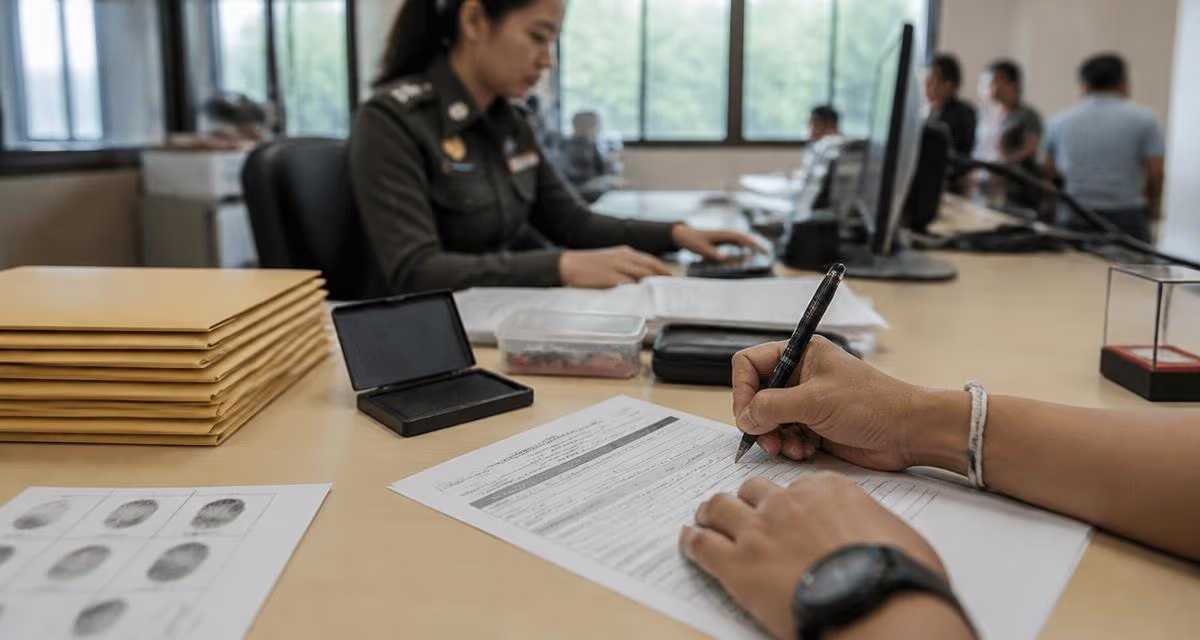
Obtaining and onward-certifying a police clearance certificate — Approximately 15–35 business days in total. Timeframes are approximate and depend on each authority's queue and how complete your file is.
Applying for a Thai police clearance certificate with fingerprint capture
Short answer: what Police Clearance Certificate actually involves
Police Clearance Certificate is the process of obtaining and onward-certifying a police clearance certificate. It requires 6 core documents, starting with original passport plus a copy of the biodata page, and runs through 6 steps, from confirm the exact certificate type and country the destination requires to proceed to translation, MFA or embassy legalisation as the destination requires. Approximately 15–35 business days in total. Certification is signed by a Notarial Services Attorney registered with the Lawyers Council of Thailand, and documents used abroad must be legalised in the order the receiving authority requires.
Key facts at a glance
Service
Police Clearance Certificate
Core documents required
6
Document you cannot start without
Original passport plus a copy of the biodata page
Number of steps
6
First step
Confirm the exact certificate type and country the destination requires (1 business day)
Final step
Proceed to translation, MFA or embassy legalisation as the destination requires (3–10 business days)
Approximate total timeframe
Approximately 15–35 business days in total
Who signs the certification
Notarial Services Attorney (NSA) registered with the Lawyers Council of Thailand
Service area
All 50 Bangkok districts and 77 provinces (documents by post or courier)
Languages handled
60+ languages
How to reach us
Call 094-895-8999 · LINE @Thainotary · Email Notary@ilc.ltd
All timeframes are approximations based on observed authority queues, not guarantees. Confirm with the receiving authority before booking travel or fixing a filing date.
Documents to prepare
Original passport plus a copy of the biodata page
Thai ID card for Thai nationals
A fingerprint card prepared on the vetting authority's prescribed form
Purpose evidence such as a request letter from the destination or the visa form
Proof of Thai address and period of stay for foreign nationals
A power of attorney if filing remotely from overseas
Step-by-step process
1. Confirm the exact certificate type and country the destination requires
Approximate timeframe: 1 business day
2. Produce a correctly formatted, clearly readable fingerprint card
Approximate timeframe: 1–2 business days
3. Lodge the application with purpose evidence and identity documents
Approximate timeframe: 1 business day
4. Await the record check against the authority's database
Approximate timeframe: 10–25 business days
5. Collect the certificate and verify name spelling, date of birth and passport number
Approximate timeframe: 1 business day
6. Proceed to translation, MFA or embassy legalisation as the destination requires
Approximate timeframe: 3–10 business days
Practical tips
Have "original passport plus a copy of the biodata page" ready first — it is the single most common cause of delay.
Check that every document spells the name exactly as in the passport before submission.
Confirm the accepted format with the receiving authority before "lodge the application with purpose evidence and identity documents".
Allow for approximately 15–35 business days in total plus public holidays in both countries.
Common pitfalls
Submitting an old photocopy instead of "original passport plus a copy of the biodata page" — many authorities reject it outright.
Skipping "produce a correctly formatted, clearly readable fingerprint card" and filing the next stage, which restarts the whole queue.
Inconsistent spelling of proper nouns between documents in the same bundle.
Counting the timeline from the day you send documents rather than the day the authority accepts a complete file.
How this differs from adjacent services
Police Clearance Certificate needs 6 documents across 6 steps (Approximately 15–35 business days in total). The step that separates it from Marriage & Personal Status and Life Certificate & Pension and Expatriate Services is "Lodge the application with purpose evidence and identity documents", where the other routes instead require Marriage & Personal Status: Have the translation legalised at the Department of Consular Affairs · Life Certificate & Pension: Verify identity against the original passport and record the certification date · Expatriate Services: Prepare accommodation and financial evidence to match the conditions.
Service
Best for
Key document
Docs / steps
Timeframe
Police Clearance Certificate
Obtaining and onward-certifying a police clearance certificate
Passport with the current visa page and latest entry stamp
6 / 6
An operating cycle of roughly 5–12 business days
The table reflects each service's actual process; timeframes are approximate and depend on the authority's queue.
Realistic timeline, step by step
Working days for each link in the chain, separating the parts we run ourselves from the parts a government office controls. Plan backwards from your deadline using the upper figure, not the lower one.
Stage
Who controls the clock
Working days
1. Police record check and PCC issuance (Royal Thai Police)Police Clearance Certificate (Royal Thai Police, Special Branch): typically about 20–30 working days after a complete filingpcscenter.sbpolice.go.th
Government authorityThe RTP publishes no fixed deadline; non-Thai applicants or cases needing extra verification take longer. NPT cannot expedite the check itself.
20–30 working days
2. Certified translationCertified translation: 1–3 working days depending on page count and language pair
Our teamRush handling is assessed case by case against translator availability.
1–3 working days
3. MFA Consular legalisation (standard service)MFA legalization (normal service): collected within 3 working days including the filing dayconsular.mfa.go.th
Government authoritySet by the Department of Consular Affairs; may extend with queue volume or document checks.
3 working days
Indicative total: 24–36 working days
Add a buffer of at least five working days before any flight, hearing or filing deadline. Documents that must travel abroad by courier need more.
Estimates based on published or observed processing times at the last review date. Authority-controlled steps can change without notice and are outside our control.
Official government fees
Fees charged by the Thai authorities themselves for this service. They are paid to the agency, not to us, and are shown here so you can budget the full cost before you start.
Authority
Charged per
Standard
Express
Official turnaround
Criminal Records Division, Royal Thai Police Source
certificate (Thai)
Request a quote
No express rate
typically 7–15 working days, subject to agency workload
Criminal Records Division, Royal Thai Police Source
certificate (English)
Request a quote
No express rate
typically 7–15 working days, subject to agency workload
Department of Consular Affairs, Ministry of Foreign Affairs Source
document (per legalization stamp)
Request a quote
Request a quote
2 working days standard / 1 working day express
Last verified: 2026-07-31 — Government fees above were last verified on 2026-07-31. Please confirm with the issuing authority before filing, as rates may change.
Our service fee is quoted separately and in writing before any chargeable work begins.
Sending Police Clearance Certificate abroad: which certification route each destination accepts
This table shows the route a Thai-issued Police Clearance Certificate document must follow to be accepted in each destination today, and how that changes once the Apostille Convention enters into force for Thailand on 28 February 2027.
Destination
Route today
From 28 Feb 2027
Receiving-side note
AustraliaContracting Party (in force there since 1995-03-16)
MFA legalisation + destination embassy
Single Apostille
Police Clearance Certificate documents still take the MFA–embassy chain until Thailand's accession takes effect; after that Australia accepts the Thai Apostille directly, though the translation must still match the receiving authority's format.
JapanContracting Party (in force there since 1970-07-27)
MFA legalisation + destination embassy
Single Apostille
Police Clearance Certificate documents still take the MFA–embassy chain until Thailand's accession takes effect; after that Japan accepts the Thai Apostille directly, though the translation must still match the receiving authority's format.
South KoreaContracting Party (in force there since 2007-07-14)
MFA legalisation + destination embassy
Single Apostille
Police Clearance Certificate documents still take the MFA–embassy chain until Thailand's accession takes effect; after that South Korea accepts the Thai Apostille directly, though the translation must still match the receiving authority's format.
ChinaContracting Party (in force there since 2023-11-07)
MFA legalisation + destination embassy
Single Apostille
Police Clearance Certificate documents still take the MFA–embassy chain until Thailand's accession takes effect; after that China accepts the Thai Apostille directly, though the translation must still match the receiving authority's format.
United StatesContracting Party (in force there since 1981-10-15)
MFA legalisation + destination embassy
Single Apostille
Police Clearance Certificate documents still take the MFA–embassy chain until Thailand's accession takes effect; after that United States accepts the Thai Apostille directly, though the translation must still match the receiving authority's format.
United KingdomContracting Party (in force there since 1965-01-24)
MFA legalisation + destination embassy
Single Apostille
Police Clearance Certificate documents still take the MFA–embassy chain until Thailand's accession takes effect; after that United Kingdom accepts the Thai Apostille directly, though the translation must still match the receiving authority's format.
GermanyContracting Party (in force there since 1966-02-13)
MFA legalisation + destination embassy
Single Apostille
Police Clearance Certificate documents still take the MFA–embassy chain until Thailand's accession takes effect; after that Germany accepts the Thai Apostille directly, though the translation must still match the receiving authority's format.
SingaporeContracting Party (in force there since 2021-09-16)
MFA legalisation + destination embassy
Single Apostille
Police Clearance Certificate documents still take the MFA–embassy chain until Thailand's accession takes effect; after that Singapore accepts the Thai Apostille directly, though the translation must still match the receiving authority's format.
TaiwanNot a Contracting Party
MFA legalisation + destination embassy
MFA legalisation + destination embassy
Taiwan is not a Contracting Party, so Police Clearance Certificate documents keep the MFA legalisation plus embassy or representative-office step even after Thailand's accession takes effect.
VietnamContracting Party (in force there since 2026-09-11)
MFA legalisation + destination embassy
Single Apostille
Police Clearance Certificate documents still take the MFA–embassy chain until Thailand's accession takes effect; after that Vietnam accepts the Thai Apostille directly, though the translation must still match the receiving authority's format.
Party status follows the HCCH status table; Thailand's entry into force is 28 February 2027. Embassy fees and queues vary, so confirm with the receiving authority before filing. If you would rather not run this yourself, we review the documents, prepare the translation and file with every authority end to end.
Frequently asked questions
The questions clients ask most about the documents, timeframes and process for this service.
What documents does Police Clearance Certificate require?
6 core items: Original passport plus a copy of the biodata page · Thai ID card for Thai nationals · A fingerprint card prepared on the vetting authority's prescribed form · Purpose evidence such as a request letter from the destination or the visa form · Proof of Thai address and period of stay for foreign nationals · A power of attorney if filing remotely from overseas. Provide originals or authority-issued certified copies, and make sure names are spelled exactly as in the passport on every document.
How long does Police Clearance Certificate take?
Approximately 15–35 business days in total. The first step, "Confirm the exact certificate type and country the destination requires", takes about 1 business day. Total time depends on each authority's queue and how complete the file is; allow for public holidays in both countries.
How many steps are involved in Police Clearance Certificate, and where does it start?
6 steps in total, starting with "Confirm the exact certificate type and country the destination requires" and closing with "Proceed to translation, MFA or embassy legalisation as the destination requires". Each step on this page carries its own timeframe so you can plan filing and usage dates in advance.
What are the common pitfalls in Police Clearance Certificate?
Submitting an old photocopy instead of "original passport plus a copy of the biodata page" — many authorities reject it outright. · Skipping "produce a correctly formatted, clearly readable fingerprint card" and filing the next stage, which restarts the whole queue. · Inconsistent spelling of proper nouns between documents in the same bundle. · Counting the timeline from the day you send documents rather than the day the authority accepts a complete file.
Any tips to get Police Clearance Certificate through faster?
Have "original passport plus a copy of the biodata page" ready first — it is the single most common cause of delay. · Check that every document spells the name exactly as in the passport before submission. · Confirm the accepted format with the receiving authority before "lodge the application with purpose evidence and identity documents". · Allow for approximately 15–35 business days in total plus public holidays in both countries.
Can your team handle the whole process for me?
Yes. Our advisers, with more than 15 years of experience, review the file, sequence the steps, file with each authority, track status and return the documents. You supply the originals and a passport copy; we report progress at each stage and advise you before work begins.
Answers reflect general practice; actual documents and timeframes vary by case and receiving authority.
Who Police Clearance Certificate suits, and when to bring in an adviser
This matter starts from 6 source documents and runs through 6 stages, with an overall approximate window of Approximately 15–35 business days in total. If your paperwork is complete and you can file in person, doing it yourself is realistic. If any of the situations below apply, a pre-filing review materially reduces the chance of rejection.
Typically the right fit when
You need Police Clearance Certificate for an authority abroad that accepts only its own prescribed format.
You are outside Bangkok or overseas and cannot attend counters in person.
You have a fixed submission date and must plan backwards from the Approximately 15–35 business days in total window.
A previous submission was returned and you want the root cause identified before refiling.
Signals you should ask before filing
A counterparty, court, or contractual deadline is involved, so mistakes are expensive to unwind.
The same document set is going to several countries, each on a different legalisation route.
Name spellings differ between documents, or a name change occurred midway.
The document is a photocopy, an old edition, or was issued by a body that no longer operates.
An adviser, not only a filing agent
Our team has handled cross-border documentation for more than 15 years. We read the receiving authority's requirements with you, check all 6 documents before anything is submitted, sequence the 6 stages around the date you actually need them, report progress at every stage, and propose a fallback route if the destination changes its requirements mid-process. Send scans first and we will tell you plainly which route is shortest for your case.
Do it yourself or let our team handle it — Police Clearance Certificate
This service involves 6 documents to prepare and 6 sequential steps, with an overall indicative timeframe of Approximately 15–35 business days in total. The table compares, realistically, what you carry when doing it alone and what is left for you when our team runs the file.
Aspect
Doing it yourself
With our team
Document preparation
You source and verify all 6 items yourself, starting with “Original passport plus a copy of the biodata page”.
We check all 6 items up front and flag anything missing on day one.
Filing at each authority
You attend and collect in person across all 6 steps, up to “Proceed to translation, MFA or embassy legalisation as the destination requires”.
Our team files on your behalf in the correct order across all 6 steps.
Your own time
Expect several trips and days off across the Approximately 15–35 business days in total window.
You submit once and collect at the agreed appointment.
Risk of rejection
A wrong translation format, a name-spelling mismatch or an expired extract means redoing that step.
Formats are matched to the destination's requirements before filing, which sharply reduces rejections.
Status tracking
You chase each authority yourself, with nobody consolidating the picture.
A dedicated case handler reports progress by phone, LINE or email.
Advisory support
You interpret the receiving authority's requirements on your own.
Advisers with 15+ years of experience choose the shortest correct document route for your case.
Note: processing times at government offices and embassies are outside any provider's control. We do not guarantee outcomes; we make sure the file is correct and complete the first time.
Prefer not to deal with it? Send us your case details and we will map the document route and timeframe before you commit.
Why files get rejected — Police Clearance Certificate
The 5 most common reasons a Police Clearance Certificate file is returned, each with a preventive action you can take before filing.
1. Set assembled out of order at the "Lodge the application with purpose evidence and identity documents" stage
Order the bundle exactly as the destination specifies and attach a cover index so an officer can verify it quickly, which reduces returns.
2. Name spelling does not match the passport
Lock spelling to the passport page as the single standard across the whole set, and disclose former names with the change-of-name evidence.
3. Certification format does not match what the destination requires
Obtain a letter or email from the receiving authority stating the accepted format, and keep it as your reference at submission time.
4. A trailing supporting document is missing, e.g. "A power of attorney if filing remotely from overseas"
Keep a checklist and one full backup copy of the bundle so a correction round can be filed immediately without restarting.
5. Incomplete scans, or stamped pages that are not legible
Scan every page in colour, including blank and reverse sides carrying seals, then re-check against all 6 listed documents before sending.
If you would rather not risk a rejection or spend days at counters, our advisory team pre-checks the full bundle before submission. Reach us by phone, LINE or email.
Worked scenarios — Police Clearance Certificate
3 situations we handle most often in Police Clearance Certificate work, with the exact order of remedy our team uses, so you can benchmark your own case before starting.
1. Requesting a Thai police clearance while living abroad
The applicant now lives overseas but the destination requires a Thai police clearance certificate, which normally involves fingerprinting and filing inside Thailand.
Take fingerprints at a police station or an authorised body in the country of residence on a card showing full name, date of birth and the officer taking the prints, then authorise a representative in Thailand to file with the Royal Thai Police Special Branch together with a certified passport copy.
Smudged or double-rolled prints are refused and the whole card has to be redone, costing another shipping cycle. Photograph the card and have it checked before posting.
2. Former names not covered by the record check
The applicant changed name and surname, so the result covers only the current name and the destination says the record does not span the required period.
Attach every name and surname change certificate in chronological order and list all former names on the application so the search covers each of them.
If former names are not declared at the outset, the certificate is issued in the current name only and the destination may require the entire process to be repeated.
3. The certificate must flow into legalisation before it expires
The destination requires a police clearance issued within the last three to six months, and it still has to pass through several certification layers before filing.
Count backwards from the real filing date, move the certificate into certification immediately on issue rather than letting it sit, and prepare the translation in advance so it can enter the chain the same week.
Validity runs from the issue date, not the final seal date. Holding this certificate to file it alongside slower documents is what usually causes it to expire.
If you would rather not learn this by trial and error, send us scans and our advisers — 15+ years on files of exactly this type — will map the correct sequence and the risk points in your case, and can then run every stage for you.
Note: these are professional worked scenarios for document preparation. They are not client testimonials and are not a guarantee of any authority's decision.
Key terms to understand before starting Police Clearance Certificate
These terms cause more rejected files in Police Clearance Certificate than translation errors do. The definitions below reflect how Thai offices and receiving authorities actually apply them.
Validity window
How long the receiving authority accepts a document after its issue date — commonly 3–6 months for police clearance certificates. Plan backwards from the filing date, not from the day you start.
Legalisation
The Department of Consular Affairs (MFA Thailand) certifies the signature and seal of the issuing officer, after which the destination embassy adds its own attestation. This is the standard route until Thailand's Apostille takes effect on 28 February 2027.
Power of Attorney (POA)
A document authorising another person to act within a stated scope. State the scope, validity period and reference numbers precisely — overly broad wording is a frequent rejection reason.
Certified translation
A translation accompanied by a statement that it is complete and accurate, with the translator's name, signature, date and contact details. The exact wording accepted varies by receiving authority.
Sworn / accredited translator
A translator registered with a court, ministry or accreditation body (e.g. NAATI in Australia). Thailand has no European-style sworn-translator register, so certified translation plus legalisation is used instead.
Notarisation (Notarial Services Attorney)
An attorney registered with the Lawyers Council of Thailand certifies that the signer signed in front of them, or that a copy matches the original. It does not certify that the contents are true.
If you are unsure which case applies to you, send the document images and the name of the receiving authority. Our advisers, who have handled cross-border documents for over 15 years, will map the route that actually works for your file.
Pre-submission readiness checklist for Police Clearance Certificate
Clear these seven checks before starting Police Clearance Certificate and you remove almost every common cause of rejection. Each item states the reason so you can verify it yourself.
1. Issue date still within the validity window the destination accepts (often 3 or 6 months)
Why it matters: Status and company documents usually expire. If the certificate ages out while it is moving through multi-step legalisation, the whole chain must be redone.
2. Colour scans at 300 dpi or better, full page edges visible, no shadows or cropped corners
Why it matters: Many authorities reject tilted phone photos because seals cannot be verified. One clean re-scan is faster than waiting a week for a rejection notice.
3. Decide the delivery method up front: in person, international courier, or filing by a representative
Why it matters: Some authorities only accept envelopes sent directly by the issuer or by a law office. Knowing this early lets the bundle and the power of attorney be prepared in a single round.
4. Put a monitored email and phone number on the form, and allow mail from government domains
Why it matters: Requests for further evidence arrive by email with a deadline. If the notice lands in spam and the deadline passes, the file is closed and must be filed again from scratch.
5. Keep a full copy set and digital scans of every certification layer before sending the originals abroad
Why it matters: Originals are rarely returned. If the destination later asks for clarification, the retained certified copies answer it immediately instead of re-ordering the whole document.
6. Translation covers every element: stamps, signatures, marginal notes and reverse-side text
Why it matters: Reviewers compare page against page. An untranslated seal or back-page note makes the translation incomplete and blocks the next certification step.
7. Signatory's authority matches the latest company affidavit and the registered signing format
Why it matters: If the required combination of directors or the registered seal is missing, the document does not bind the company and fails at the very first certification layer.
If you would rather not run the checks yourself, send the document images and the name of the receiving authority. Our advisory team, with 15+ years on cross-border documents, reviews them before filing and then handles every certification layer through to the destination.
Police Clearance Certificate: what we handle and what you prepare
This table separates, stage by stage, which parts of Police Clearance Certificate sit with our team and which parts remain with you, so you can weigh the time and effort involved before committing.
Stage
We handle
You prepare
Obtaining and collecting source documents
File requests with the issuing offices, follow the queue, and verify each issued copy before it moves to the next stage.
Sign the power-of-attorney form and provide a valid ID card or passport copy.
Delivery and real-world use
Deliver to you or forward to the destination as agreed, with a short brief on how each document is used and what must never be done to it (unstapling, over-stamping).
Provide the delivery address or recipient, and store the documents as advised.
Translation and translation review
Translate every element including seals and reverse-side text, align name spelling with the passport, then have a second linguist review it.
Confirm the romanised spelling of your name and flag any terminology the destination has previously required.
Record-keeping and future reuse
Organise the set, record each document's expiry, and flag in advance when a renewal or fresh extract is due.
Tell us about upcoming business or travel plans so documents can be prepared ahead of time.
Quality gate before handover
Check certificate numbers, dates, seals, page order and name consistency across the set, and archive a digital copy for you.
Review your personal details on the proof copy we send before the file is closed.
Case assessment before we start
Read the receiving authority's requirements, map which documents are needed, how many certification layers apply, and whether a legitimate shortcut exists.
Send photos of the documents you already hold, the destination authority or country, and your deadline.
We do not simply process files. Every case starts with advice from a team with 15+ years in cross-border documentation: we work out the shortest route that still complies with the rules, and warn you in advance about the points where files are usually rejected.
If you would rather not chase each step yourself, send photos of your documents and the name of the receiving authority. We will map the route, the required documents and a realistic timeframe, then carry out the whole process for you.
After your Police Clearance Certificate documents are delivered: keeping them usable
A file is not finished when it reaches your hands — it is finished when the receiving authority accepts it. This table covers what to look after once Police Clearance Certificate is complete, so the documents you paid for stay valid.
Topic
What to do
If ignored
How long the document stays acceptable
Most receiving authorities count validity from the issue date of the source document, not from the certification date. Submit as soon as you receive the file and diary the issue date.
Filing after the authority's window means re-ordering the source document and repeating every certification layer.
Reusing a certified translation
Store the translation together with the translator's certification page. If the source document is unchanged, the same translation can usually be carried forward and only the next certification layer repeated.
Losing the certification page invalidates the translation and forces a full retranslation.
When re-legalisation is required
Redo the chain when the destination country changes, the purpose of use changes, the wording is amended, or the authority updates its form. Renewals in the same country usually accept the same set.
Reusing a set across borders without checking risks refusal because the certification chain no longer matches the new destination.
Originals versus certified copies
Keep the wet-sealed original in your own file and submit certified copies where accepted. If several authorities need the document at once, order multiple sets in the first round.
Ordering later restarts the certification queue, and many authorities never return a submitted original.
Keeping proof of submission
Photograph the complete set before handing it over, and keep the receipt, reference number, receiving officer's name and filing date in the same folder.
If a file goes missing you have no evidence it was ever lodged, and the process restarts.
With more than 15 years handling cross-border documents, our team does not close a case at delivery. We keep advising whether the same set works for another destination, which layer must be redone, and what to prepare for the next round.
Unsure whether the documents you already hold are still usable? Send photos and the destination authority's name. We will tell you plainly what can be reused, what must be redone, and handle the rest for you.
What you actually receive from Police Clearance Certificate
Most people know they need Police Clearance Certificate but not what the finished package physically looks like. This table lists every deliverable, what it contains, and what to inspect yourself before filing.
Deliverable
What it contains
Check before filing
MFA consular legalization stamp
The Department of Consular Affairs (Chaeng Watthana) legalization sheet bearing its number, date and signing officer, attached to the set. Thailand's apostille regime starts 28 February 2027.
Verify the legalization number is legible, not pierced by a staple, and still within the destination's accepted age window.
Courier tracking and proof of delivery
EMS / DHL / FedEx tracking numbers, photographs of the set before it is sealed, and the destination signature record, so the document's journey is auditable end to end.
Verify the recipient name and postcode against the address the receiving authority actually publishes before dispatch is confirmed.
Translator's certification page
A certification sheet naming the translator, their registration or credential, the language pair, the date, and a signed statement that the translation is a true rendering of the source.
Check every letter of the name against the passport — name mismatches are one of the most common rejection causes.
High-resolution scan pack
300 dpi colour scans of every page including stamped reverse sides, systematically named and delivered by email or LINE for online filing and as your backup copy.
Confirm stamps are legible, there are no edge shadows, and file sizes fit the destination portal's limit.
Certified original set
The source document or certified copy bound together with the translation as one sealed set, stamped in the format the receiving authority accepts — never separated into loose sheets.
Confirm the page order is complete, the seal crosses the binding intact, and no one removes the staple before submission.
Our advisory team has worked on these files for over 15 years. We do not simply hand the pack over: we walk the right-hand column with you item by item and explain what the receiving officer looks at first. If you would rather not run the process yourself, send photos of your documents by phone, LINE or email and we will assess and handle every stage.
Deliverable formats vary by receiving authority. Always confirm current requirements with the receiving office before filing.
Choosing the right Police Clearance Certificate route from day one
Most Police Clearance Certificate failures do not happen during the work — they happen at the moment the route is chosen. This table sets out the questions to answer before starting and what each answer commits you to.
Question to answer first
If the answer is the first case
If the answer is the second case
What choosing wrong costs
Does the receiving authority require an original, or will a certified copy be accepted?
Original required — order a fresh copy from the issuing authority and budget its issuance time before starting the certification chain.
Certified copy accepted — an attorney-certified true copy is enough, saving time and avoiding the risk of releasing your only original.
Sending a copy where an original is demanded means immediate rejection and restarting the whole timeline.
Is your deadline the filing date, or the date the documents must physically arrive?
Filing date — count backwards from the appointment and add business days for every certification layer plus public holidays in both countries.
Arrival date — you must also add international transit and customs handling, which routinely takes longer than expected.
Anchoring on the wrong date means finishing after the deadline, and fees already paid are usually non-refundable.
Does the name spelling match your passport on every single document?
Yes on all documents — you can start the chain now; lock this spelling and reuse it in every future translation.
No (name change, marriage, different transliteration) — prepare the name-change certificate or marriage record and certify it alongside the main set.
A single-letter name mismatch is the most common rejection cause and is usually discovered on filing day.
Does your document have a validity window (for example three or six months from issue)?
Yes — start the certification chain as close to the filing date as possible; do not obtain the document far in advance.
No — you can obtain it early, and doing so before peak season shortens the queue at each office.
If it expires in transit you must reorder the document and repeat every certification step from the beginning.
Do you want to run the process yourself, or have the team handle it end to end?
Partly yourself — sensible if you are in Thailand and free on business days; we assemble the set and give you the filing order.
Fully handled — send photos of your documents by phone, LINE or email; the team assesses, assembles, files, tracks and returns the finished set.
Overestimating your own availability is the most common reason a file stalls midway, especially where several offices must be visited on one day.
Our advisory team has worked this field for over 15 years. We are not only a filing agency: we walk these questions with you one by one before any work starts, so no document cycle is wasted. If you would rather not handle it, send photos of your documents by phone, LINE or email — we will assess the correct route and run every stage for you.
Receiving-authority requirements change. Always confirm the current rules with the receiving office before filing.
We take on Police Clearance Certificate work as advisers, not merely as a filing agency. Below are the situations clients raise most often, the questions our team asks before answering, the professional advice we give, and what we then do on your behalf.
A client calls and says: “I have to file this week — can you make it?”
What we ask first
We ask first whether the deadline is the online submission date, the interview date, or the date the paper file must physically arrive. Those are three different timelines.
Our advice
For an online submission a scan usually suffices with originals to follow. If the deadline is physical arrival abroad, international transit time must be deducted from the working window before anything else is planned.
What we do for you
We build the timeline backwards from your deadline before starting, identify where expedited handling genuinely exists, and tell you plainly if the window is too short instead of accepting the job regardless.
The client read a requirement in an online group that contradicts what we advised.
What we ask first
We ask which year that information dates from, which office it was filed at, and whether the poster held the same nationality.
Our advice
Document requirements vary by office, nationality and period, so another applicant's account is usually true for their case and not for yours. The receiving authority's own published notice always governs.
What we do for you
We re-verify with the authority before each filing round, and if a rule changes mid-process we adjust the plan immediately and explain the reason in writing.
The client needs the same documents for several countries at once.
What we ask first
We ask whether each destination accepts a certified copy or retains the certified original, and whether filings are simultaneous or staggered.
Our advice
Do not certify a single set and hope to reuse it — many embassies retain the original. Ordering multiple source copies at the outset and running parallel certification chains is usually cheaper and faster.
What we do for you
We size the number of sets on day one, run the chains in parallel to compress total time, and hand over one filing-ready bundle per destination.
The name is spelled differently on the passport, the house registration and an older translation.
What we ask first
We ask to see every document on which the destination authority has already seen your name, including old visas and previously filed certificates.
Our advice
The rule is to anchor on the passport spelling and tie the variants together with a translator's note confirming one and the same person — never by altering a source document.
What we do for you
We prepare a spelling concordance across all documents, issue the translator's note authorities accept, and make every document in the bundle consistent before certification starts.
Our advisory team has over 15 years in documentation, translation and legalisation. An initial consultation to map the route and the document list is free of charge. If you would rather not handle it yourself, send photographs of the documents by phone, LINE or email and we will plan and execute every step for you.
This is general practice guidance, not case-specific legal advice. Receiving authorities change their requirements; always confirm the current rules before filing.
Official sources for Police Clearance Certificate
Every requirement stated for Police Clearance Certificate traces back to an authority that actually issues the rule, not to hearsay. Below are the bodies that govern this work and what you should check yourself before filing.
Legalisation of signatures and seals on Thai official documents and their translations for overseas use.
Accepted translation format, service hours, appointment channel and current official fees.
Our advisers track these authorities' notices as routine work and bring more than 15 years of hands-on practice. If you would rather not read the regulations yourself, send document photos by phone, LINE or email and we will confirm the correct route, the exact paperwork, and handle the whole process for you.
Information as of August 2026 · Fees, processing times and document lists are set by each authority and can change. Always confirm with the authority before you proceed.
Service standards and advisory team for Police Clearance Certificate
We do not simply "collect your papers and queue at a counter". Every Police Clearance Certificate case starts by reading what the receiving authority actually accepts, then sequencing the certification chain correctly from the first document. Below are the standards we hold on every case, the people responsible, and the aftercare you get.
Service standards (SLA) we hold on every case
Item
Our standard
What you receive
First response
Same business day (Mon–Fri 09:00–18:00); LINE is answered daily 09:00–18:00.
An early read on whether the documents you already hold will be accepted, before you spend anything.
Pre-acceptance document review
Every page checked, with a clear list of items to re-issue or correct for name and date consistency.
A checklist written for your case, not a generic one.
Indicative timeframe
Approximately 15–35 business days in total
A step-by-step schedule showing which stages depend on government queues.
Status reporting
An update at every stage change and an immediate alert if we see rejection risk.
You always know where the file is without chasing us.
Revisions to translations and certificates
We revise until the format matches what the receiving authority requires, at no extra preparation charge.
Any official re-filing fee is quoted separately and transparently.
Confidentiality
Work is handled under professional confidentiality duties and Thailand's Personal Data Protection Act.
Scanned files are restricted to the people assigned to your case.
Six-layer quality check before delivery
Most Police Clearance Certificate rejections are not about substance. They come from small details: a spelling that differs from the passport, a certification chain done out of order, or a document older than the destination accepts. So we re-check in layers:
1) Source-document validity
Confirm the copy is a type the destination accepts, freshly issued within the allowed window, with all seals and signatures present.
2) Identity-data consistency
Match names, dates of birth and document numbers against the passport and every other paper in the same bundle.
3) Second-linguist translation review
Translator and reviewer are never the same person; focus on legal terminology, authority names and transliteration of proper nouns.
4) Certificate format check
Certification wording, letterhead, binding and seal placement must match the format the receiving authority expects.
5) Certification-order check
Verify original → translation → certifying authority → embassy is correct before filing, so nothing has to restart.
6) Delivery-set check
Count the sets, verify high-resolution scans, and attach a note stating which authority each document is for.
The team on your case
A Police Clearance Certificate case is never handled by one person alone — there is always a preparer and a reviewer. Our core team has worked on cross-border documentation for more than 15 years.
Lead case advisor
15+ years
Reads the destination requirements, designs the certification route and stays your single point of contact.
Notarial services attorney
Registered with the Lawyers Council of Thailand
Certifies signatures, true copies and affidavits within the powers granted by law.
Specialist translators
Legal, government and medical streams
Produce translations matching the terminology and layout the receiving authority accepts.
Quality reviewer (second pair of eyes)
Independent of the preparer
Runs all six checking layers before anything leaves the office.
Filing officers
Assigned to consular and embassy routes
File, track queues and collect documents with a status report.
Aftercare
We retain a digital copy of the bundle for the agreed period, so repeat sets can start immediately.
We flag expiry dates on time-limited items such as police clearance certificates or company affidavits.
Follow-up advice is included when the receiving authority asks for something extra — no need to open a new case.
If a document is ever rejected, we take it back up at once with a written cause and the fastest available fix.
If you would rather not decode the requirements yourself
Send photos of what you already hold and tell us the destination country or authority. Our advisors will tell you which Police Clearance Certificate route applies, how many documents it needs, roughly how long it takes and where cases usually get rejected. If you ask us to handle it, we manage everything from bundle assembly and translation to certification and delivery in a single pass.
Information as of 2026 · These standards describe our own working practice. They are not a guarantee of any government or embassy decision. Timeframes are indicative and depend on official queues.
Handling this from outside Bangkok
Police Clearance Certificate does not require you to travel to Bangkok for every step. Clients in these 10 provinces routinely run the whole file by courier with online status updates. Upcountry points are document hand-over points for our mobile team, not walk-in offices.
How the remote workflow runs
Send photos or scans first so we can confirm you are using the correct, still-valid version.
Ship the originals with tracking, together with a passport or ID copy.
We file with each authority in sequence and report progress at every stage.
Documents are returned to your address, or forwarded to the receiving party as agreed.
If your province is not listed, the service still works the same way, because the decisive filings happen with Bangkok authorities regardless. Our advisers, with more than 15 years of experience, pre-check the file before you ship it so no courier trip is wasted.
Police Clearance Certificate near me — real service points and coverage
We deliver Police Clearance Certificate across all 78 Thai provinces. The table below separates staffed offices from document hand-over points, so you can plan travel accurately: anything not marked as an office is a meeting point used by our mobile team, not a walk-in branch.
Service point
Area covered
What to know
Bangkok HQ — Lat Phrao 95
Bangkok, the five surrounding provinces and all central-authority filings
Staffed head office near MRT Lat Phrao; the base for filings at the Department of Consular Affairs (Chaeng Watthana), the courts and Bangkok embassies.
Khon Kaen Branch
Khon Kaen, Maha Sarakham, Roi Et, Kalasin and Chaiyaphum
Central-Isan hand-over point, typically for civil-registry and education documents issued in the region before the Bangkok certification steps.
Udon Thani Branch
Udon Thani, Sakon Nakhon, Loei and Nong Bua Lam Phu
A region with many binational families; the recurring files are affirmations of freedom to marry, marriage records and life certificates for overseas pension funds.
Nong Khai Branch
Nong Khai, Bueng Kan and cross-border files on the Lao PDR side
Close to the first Thai–Lao Friendship Bridge, for documents needed on both sides of the border and files that must be certified before leaving Thailand.
Provinces we work in routinely
Police Clearance Certificate is available in all 78 provinces. Steps that must be filed with central authorities are handled by our Bangkok team on your behalf, so no travel is required from you.
Bangkok · Nonthaburi · Pathum Thani · Samut Prakan · Samut Sakhon · Samut Songkhram · Nakhon Pathom · Phra Nakhon Si Ayutthaya · Ang Thong · Lopburi · Sing Buri · Chai Nat · Saraburi · Nakhon Nayok · Suphan Buri · Kanchanaburi · Ratchaburi · Phetchaburi · Prachuap Khiri Khan · Uthai Thani · Nakhon Sawan · Phichit · Phitsanulok · Phetchabun · Kamphaeng Phet · Sukhothai · Chiang Mai · Chiang Rai · Lampang · Lamphun · Mae Hong Son · Nan · Phayao · Phrae · Uttaradit · Tak · Nakhon Ratchasima · Khon Kaen · Udon Thani · Ubon Ratchathani · Nong Khai · Bueng Kan · Loei · Nong Bua Lamphu · Sakon Nakhon · Nakhon Phanom · Mukdahan · Kalasin · Roi Et · Maha Sarakham · Yasothon · Amnat Charoen · Buri Ram · Surin · Si Sa Ket · Chaiyaphum · Chonburi · Rayong · Chanthaburi · Trat · Chachoengsao · Prachin Buri · Sa Kaeo · Phuket · Krabi · Phang Nga · Ranong · Surat Thani · Nakhon Si Thammarat · Chumphon · Songkhla · Hat Yai · Satun · Trang · Phatthalung · Pattani · Yala · Narathiwat
Rather not spend days queueing at several authorities? Send document photos for a free pre-check: advisers with 15+ years of experience will tell you what is required, how many days it takes and where files are usually rejected — then run the whole process for you.
An advisory team, not just a filing service
Our team has worked on cross-border documentation for more than 15 years. We start from where the document must be accepted, then design the shortest sequence that the receiving authority will accept.
An upfront review of whether the documents you already hold are sufficient, and what has to be re-issued
Route selection matched to the receiving authority's own requirements, without unnecessary stages
Early warning on rejection risks such as inconsistent name spelling or a translation format the destination will not accept
Sequencing advice when several matters must run in parallel, such as a visa alongside a work permit
Follow-up support after delivery, if the receiving authority asks for anything further
All timeframes are approximate and depend on each authority's queue. Acceptance and adjudication always remain at the discretion of the receiving authority.
We can run every step above end to end: document review, translation, certification, filing with each authority, and return delivery. You provide the originals and a passport copy; we handle the rest and report progress at each stage.
Real customer questions, answered by our attorneys
Selected from our knowledge base of 3,300+ real questions we have answered.
How many buffer days should be planned so a PCC for adoption and child-related work finishes before the receiving authority's appointment?
Police clearance
How we handle this in practice to "How many buffer days should be planned so a PCC for adoption and child-related work finishes before the receiving authority's appointment?" — If you are outside Thailand, take your fingerprints at any local police station or Royal Thai Embassy on form FD-258 or Thai form Tor.Tor.14, mail the originals to us, and we submit them to CRD the next business day. The Thai Police Clearance Certificate is issued by the Criminal Records Division (CRD) of the Royal Thai Police in Bangkok, accepted by Australian Home Affairs, USCIS/NVC, UKVI, IRCC (Canada), all Schengen embassies, and by AHPRA / Engineers Australia / VETASSESS / CPA Australia when a good-character check is required. Send a photo of your passport to LINE @Thainotary and we'll quote and schedule fingerprinting within 15 minutes.
Process in brief: (1) decide whether the destination requires an original or a certified true copy; (2) prepare a power of attorney if you cannot attend; (3) translate in the required format; (4) file and monitor the queue; (5) verify whether supporting documents are also required at destination.
What to prepare: the original or a certified extract from the issuing authority, a copy of the holder's ID or passport, a power of attorney if someone files on your behalf, and the exact English spelling of every name as it appears in the passport.
Common pitfall: many destinations accept documents only within 3–6 months of issue or certification. Missing that window means re-issuing and re-certifying the entire set, so plan backwards from the real filing date.
Practitioner's tip: if the same document is needed by several authorities, produce all copies in one round — it saves time and keeps the certification format consistent across the sets.
Living in Khon Kaen, do I have to travel to Bangkok for applying for a Thai Police Clearance Certificate, or can documents be couriered both ways?
Police clearance
Per Royal Thai Police CRD (Criminal Records Division) to "Living in Khon Kaen, do I have to travel to Bangkok for applying for a Thai Police Clearance Certificate, or can documents be couriered both ways?" — Agency-handled turnkey service is quoted per case (standard 7–15 business days, express 3–5 business days), plus the government fee. Includes power of attorney, fingerprinting, CRD filing, English translation, MFA legalisation and Apostille (Thailand joined the Hague Apostille Convention 14 Feb 2025). Documents required: passport (all stamped pages), Thai ID + house-registration if Thai citizen, two 2×2-inch photos, purpose letter from the embassy/employer if any, and our notarised Power of Attorney (we provide the template). Worldwide DHL/EMS dispatch — call 094-895-8999 to book a mobile fingerprinting slot.
Process in brief: (1) decide whether the destination requires an original or a certified true copy; (2) prepare a power of attorney if you cannot attend; (3) translate in the required format; (4) file and monitor the queue; (5) verify whether supporting documents are also required at destination.
What to prepare: an intact original that is not torn or laminated, evidence of any name change where the document does not match your current name, a passport copy, and a power of attorney with ID copies of both grantor and agent.
Common pitfall: states that objected to Thailand's accession to the Apostille Convention still require destination-embassy legalisation, so confirm the destination's position before starting.
Practitioner's tip: send us photographs of the documents before work begins. We will confirm the correct chain, an honest timeline, and anything still missing so you do not lose a filing slot.
How many days does an express track actually save for a spouse or dependant visa, what extra costs apply, and what risks should be weighed first?
Police clearance
Practitioner's view to "How many days does an express track actually save for a spouse or dependant visa, what extra costs apply, and what risks should be weighed first?" — If you are outside Thailand, take your fingerprints at any local police station or Royal Thai Embassy on form FD-258 or Thai form Tor.Tor.14, mail the originals to us, and we submit them to CRD the next business day. The Thai Police Clearance Certificate is issued by the Criminal Records Division (CRD) of the Royal Thai Police in Bangkok, accepted by Australian Home Affairs, USCIS/NVC, UKVI, IRCC (Canada), all Schengen embassies, and by AHPRA / Engineers Australia / VETASSESS / CPA Australia when a good-character check is required. Send a photo of your passport to LINE @Thainotary and we'll quote and schedule fingerprinting within 15 minutes.
Process in brief: (1) decide whether the destination requires an original or a certified true copy; (2) prepare a power of attorney if you cannot attend; (3) translate in the required format; (4) file and monitor the queue; (5) verify whether supporting documents are also required at destination.
What to prepare: the full original set, colour scans of every page for translation proofing, an English spelling list for all people and place names, and any extra items listed on the destination authority's own checklist.
Common pitfall: never unstaple or re-bind a certified set. Removing the staple is treated as breaking the seal and the destination may reject the whole file; photocopy without dismantling it.
Practitioner's tip: keep colour scans of every certified page. If a courier loses the set, digital copies make re-issue and verification dramatically faster.
What is the total cost of a Thai police clearance certificate for a foreign citizenship or naturalisation application, and how is it split between the government fee and the agency handling fee?
Police clearance
Quick summary for expats & migration agents to "What is the total cost of a Thai police clearance certificate for a foreign citizenship or naturalisation application, and how is it split between the government fee and the agency handling fee?" — The Thai Police Clearance Certificate is issued by the Criminal Records Division (CRD) of the Royal Thai Police in Bangkok, accepted by Australian Home Affairs, USCIS/NVC, UKVI, IRCC (Canada), all Schengen embassies, and by AHPRA / Engineers Australia / VETASSESS / CPA Australia when a good-character check is required. If you are outside Thailand, take your fingerprints at any local police station or Royal Thai Embassy on form FD-258 or Thai form Tor.Tor.14, mail the originals to us, and we submit them to CRD the next business day. Send a photo of your passport to LINE @Thainotary and we'll quote and schedule fingerprinting within 15 minutes.
Process in brief: (1) assemble the complete file before filing — partial filings lose a queue slot; (2) match every spelling to the passport; (3) file the whole set together so the stamps carry one date; (4) inspect the stamps at the counter; (5) ship with tracked delivery.
What to prepare: an intact original that is not torn or laminated, evidence of any name change where the document does not match your current name, a passport copy, and a power of attorney with ID copies of both grantor and agent.
Common pitfall: the single largest cause of rejection is an English spelling that does not match the passport. Always take the passport spelling as authoritative and confirm it before translation starts.
Practitioner's tip: treat the destination authority's own published checklist as the final reference; country-specific rules change, and we will review that checklist with you before filing.
What is the realistic working-day timeline for a Thai police clearance certificate from the Royal Thai Police from drop-off to usable document, and which stage slips most often?
Police clearance
Per Royal Thai Police CRD (Criminal Records Division) to "What is the realistic working-day timeline for a Thai police clearance certificate from the Royal Thai Police from drop-off to usable document, and which stage slips most often?" — The certificate is valid for 3–6 months depending on the receiving authority. We can courier the sealed original via DHL/EMS worldwide with door-to-door tracking. We offer nationwide Mobile Fingerprinting (Bangkok, Chiang Mai, Phuket, Pattaya, Khon Kaen, Udon Thani, Nong Khai) so you never need to visit the CRD in person — the entire process can be done by Power of Attorney. Free consultation on LINE @Thainotary or call 094-895-8999 (Mon–Sun 08:00–20:00 ICT).
Process in brief: (1) confirm the original was issued by the competent authority and is still within the accepted validity window; (2) have it translated by a translator the destination accepts; (3) obtain certification of the signature/translation; (4) add destination-embassy legalisation only where Apostille is not accepted; (5) proof names, dates and reference numbers before dispatch.
What to prepare: an intact original that is not torn or laminated, evidence of any name change where the document does not match your current name, a passport copy, and a power of attorney with ID copies of both grantor and agent.
Common pitfall: the single largest cause of rejection is an English spelling that does not match the passport. Always take the passport spelling as authoritative and confirm it before translation starts.
Practitioner's tip: treat the destination authority's own published checklist as the final reference; country-specific rules change, and we will review that checklist with you before filing.
For a foreign-issued source record, how do cost and turnaround compare between a Thai police clearance certificate from the Royal Thai Police and a certified translation of the PCC?
Police clearance
Per Royal Thai Police CRD (Criminal Records Division) to "For a foreign-issued source record, how do cost and turnaround compare between a Thai police clearance certificate from the Royal Thai Police and a certified translation of the PCC?" — We offer nationwide Mobile Fingerprinting (Bangkok, Chiang Mai, Phuket, Pattaya, Khon Kaen, Udon Thani, Nong Khai) so you never need to visit the CRD in person — the entire process can be done by Power of Attorney. The certificate is valid for 3–6 months depending on the receiving authority. We can courier the sealed original via DHL/EMS worldwide with door-to-door tracking. Free consultation on LINE @Thainotary or call 094-895-8999 (Mon–Sun 08:00–20:00 ICT).
Process in brief: (1) tell us the destination country and purpose so the correct chain is set from day one; (2) re-issue the original if it is older than the destination's limit; (3) translate and proofread twice against the source; (4) certify in the correct order; (5) return the sealed set with a digital copy for your records.
What to prepare: the original or a certified extract from the issuing authority, a copy of the holder's ID or passport, a power of attorney if someone files on your behalf, and the exact English spelling of every name as it appears in the passport.
Common pitfall: never unstaple or re-bind a certified set. Removing the staple is treated as breaking the seal and the destination may reject the whole file; photocopy without dismantling it.
Practitioner's tip: treat the destination authority's own published checklist as the final reference; country-specific rules change, and we will review that checklist with you before filing.
Will a minor compound criminal offense that was settled out of court negatively impact my police clearance issuance?
Police clearance
Short answer to "Will a minor compound criminal offense that was settled out of court negatively impact my police clearance issuance?" — Documents required: passport (all stamped pages), Thai ID + house-registration if Thai citizen, two 2×2-inch photos, purpose letter from the embassy/employer if any, and our notarised Power of Attorney (we provide the template). Agency-handled turnkey service is quoted per case (standard 7–15 business days, express 3–5 business days), plus the government fee. Includes power of attorney, fingerprinting, CRD filing, English translation, MFA legalisation and Apostille (Thailand joined the Hague Apostille Convention 14 Feb 2025). Worldwide DHL/EMS dispatch — call 094-895-8999 to book a mobile fingerprinting slot.
Process in brief: (1) confirm the original was issued by the competent authority and is still within the accepted validity window; (2) have it translated by a translator the destination accepts; (3) obtain certification of the signature/translation; (4) add destination-embassy legalisation only where Apostille is not accepted; (5) proof names, dates and reference numbers before dispatch.
What to prepare: the original, a signed certified-true copy, a completed application form, a contact number reachable during office hours, and the name of the destination authority so the correct certification format is applied.
Common pitfall: states that objected to Thailand's accession to the Apostille Convention still require destination-embassy legalisation, so confirm the destination's position before starting.
Practitioner's tip: give us your travel or filing deadline up front. We plan backwards and pick the service tier that lands on time without paying for unnecessary express handling.
How many processing days does it usually take to issue a Thai Police Clearance Certificate?
Police clearance
How we handle this in practice to "How many processing days does it usually take to issue a Thai Police Clearance Certificate?" — If you are outside Thailand, take your fingerprints at any local police station or Royal Thai Embassy on form FD-258 or Thai form Tor.Tor.14, mail the originals to us, and we submit them to CRD the next business day. The Thai Police Clearance Certificate is issued by the Criminal Records Division (CRD) of the Royal Thai Police in Bangkok, accepted by Australian Home Affairs, USCIS/NVC, UKVI, IRCC (Canada), all Schengen embassies, and by AHPRA / Engineers Australia / VETASSESS / CPA Australia when a good-character check is required. Send a photo of your passport to LINE @Thainotary and we'll quote and schedule fingerprinting within 15 minutes.
Process in brief: (1) check whether a parent authority must endorse the document first — a school, hospital or line department; (2) translate into the required language; (3) certify the translation; (4) complete the next certification layer; (5) submit within the validity window the destination accepts.
What to prepare: the original, a signed certified-true copy, a completed application form, a contact number reachable during office hours, and the name of the destination authority so the correct certification format is applied.
Common pitfall: self-made or machine translations are usually refused — reviewers check the letterhead, the translator's certification wording, and whether every stamp on the original has been rendered.
Practitioner's tip: give us your travel or filing deadline up front. We plan backwards and pick the service tier that lands on time without paying for unnecessary express handling.
In-depth questions and answers — Police Clearance Certificate
Answers follow the competent authority's published requirements, not marketing copy.
What should be checked first before filing for Police Clearance Certificate?
Take fingerprints on the correct form and have an authorised officer certify them. The competent authority is Police Clearance Service Centre, Royal Thai Police. This is general guidance; requirements and processing times change — verify with the competent authority before filing.
Which practices reduce correction rounds in Police Clearance Certificate?
Thai nationals abroad may be fingerprinted at a Thai embassy or consulate, or a designated local police station. The competent authority is Police Clearance Service Centre, Royal Thai Police. This is general guidance; requirements and processing times change — verify with the competent authority before filing.
What should a first-time applicant know about Police Clearance Certificate?
Foreign nationals should prepare passport pages and evidence of Thai residence in full. The competent authority is Police Clearance Service Centre, Royal Thai Police. This is general guidance; requirements and processing times change — verify with the competent authority before filing.
What is commonly overlooked in Police Clearance Certificate but affects the outcome?
For overseas use, plan translation plus legalisation or Apostille immediately after issuance. The competent authority is Police Clearance Service Centre, Royal Thai Police. This is general guidance; requirements and processing times change — verify with the competent authority before filing.
How can a Police Clearance Certificate document set be kept internally consistent?
Check the destination's acceptance window, often around 3–6 months. The competent authority is Police Clearance Service Centre, Royal Thai Police. This is general guidance; requirements and processing times change — verify with the competent authority before filing.
In what order should Police Clearance Certificate steps be sequenced to avoid rework?
Keep at least one copy before sending the original abroad. The competent authority is Police Clearance Service Centre, Royal Thai Police. This is general guidance; requirements and processing times change — verify with the competent authority before filing.
Why are Police Clearance Certificate documents rejected?
Observed cause: Unclear fingerprints or the wrong form, requiring a full retake. If you are unsure whether your case is affected, confirm with Police Clearance Service Centre, Royal Thai Police, or ask our staff by phone, LINE or email before filing. This is general guidance; requirements and processing times change — verify with the competent authority before filing.
Which mistake in Police Clearance Certificate forces the process to restart?
Observed cause: Names on the application not matching the passport. If you are unsure whether your case is affected, confirm with Police Clearance Service Centre, Royal Thai Police, or ask our staff by phone, LINE or email before filing. This is general guidance; requirements and processing times change — verify with the competent authority before filing.
Your case may have specific conditions — ask our staff directly.
Composite cases similar to this page — Police Clearance Certificate
Composite cases assembled from commonly seen matters — not individual clients, no personal data.
police clearance certificate from Ubon Ratchathani for a residence renewal
a Thai–foreign couple filing together from Ubon Ratchathani — the signatory and the applicant were in different provinces, so signing and shipping had to be planned
What we handled: delivered a scanned set plus the originals with lodgement instructions · tracked progress between steps and reported status along the way
What clients usually ask in matters like this: how long does the set stay valid after certification?
Indicative timeline: roughly 10–20 working days end to end
fingerprint card from Chiang Mai for an adoption process
a Thai–foreign couple filing together from Chiang Mai — the signatory and the applicant were in different provinces, so signing and shipping had to be planned
What we handled: delivered a scanned set plus the originals with lodgement instructions · sequenced the certification chain to match the destination authority's rules · arranged the signing or lodgement appointment and listed what to bring · reviewed the source documents and flagged which ones needed re-issuing before work began
What clients usually ask in matters like this: how long does the set stay valid after certification?
Indicative timeline: roughly 10–20 working days end to end
passport copy from New Zealand for a citizenship application
a Thai national working overseas from New Zealand — the signatory and the applicant were in different provinces, so signing and shipping had to be planned
What we handled: delivered a scanned set plus the originals with lodgement instructions · sequenced the certification chain to match the destination authority's rules · prepared the translation and reconciled every name spelling against the passport · reviewed the source documents and flagged which ones needed re-issuing before work began
What clients usually ask in matters like this: are true originals required, or will certified copies do?
Indicative timeline: roughly 10–20 working days end to end