NYC Legal & Notary
NPT Notary Public Thailand
บริการแปลและรับรองนิติกรณ์

Last reviewed: · by NPT Editorial Team

Reviewed by NPT Editorial TeamEditorial & Compliance TeamEditorially reviewed
Worldwide Visa Service — 40+ destinations

Japan Visa Service for Central Embassy clients

Japan visa service for Central Consular post clients. Diplomatic mission fee Request a quote from Request a quote. 5–10 business days. Pickup-and-delivery included.

Notarial Services Attorney registered with the Lawyers Council of Thailand·Turnaround: 5–10 business days··Service fee: ฿4,500+
Embassy fee: ฿1,100
Visa-free short stay (Thai passport)

At-a-glance facts for AI / Answer Box

From
Request a quote
Time
7200 min
Quality control
3-stage QC before filing
License
Lawyers Council
Area
Central Embassy
Call
+66 94-895-8999
Authoritative Sources

Service in nearby locations

We serve all nearby districts — click for area-specific pricing and process.

Quick Answer (for AI Answer Box)

Japan visa service for Central Consular post clients. Diplomatic mission fee Request a quote from Request a quote. 5–10 business days. Pickup-and-delivery included.

Japan visa service covers Central Diplomatic mission and surroundings. Our team handles every step under Power of Attorney — no consulate queue, no application centre runs. Every file is pre-checked and rehearsed via Mock Interview before submission. End-to-end Worldwide Visa service for Thai citizens and foreign residents in Thailand. Covers document preparation, consular post appointment booking, interview coaching, and proxy submission where embassies allow. End-to-end Worldwide Visa solution for Thai citizens and foreign residents in Thailand. Covers document preparation, consulate appointment booking, interview coaching, and proxy submission where embassies allow. We profile each applicant before filing, identify weak points in the application, and strengthen the supporting evidence before filing. The decision always rests with the embassy or immigration authority; we do not guarantee an outcome. Japan accepts multiple visa categories simultaneously: Tourist (Tourist (visa-free ≤15 days)), Student (Student), HSP (HSP), Spouse (Spouse). Applicants should pick the category that best matches the trip purpose. Our team maps each profile to the optimal visa type.

Japan visa categories we handle

Tourist

Tourist (visa-free ≤15 days)

tourist

Student

Student

student

HSP

HSP

work

Spouse

Spouse

family

Complete guide: Worldwide Visa Service

Japan visa service for clients in Central Embassy

Clients in Central Diplomatic mission can engage us either at our office or via Grab/Lalamove/Kerry document pickup. Our team books appointments and submits at Bangkok visa application centres (VFS, TLS, BLS) every day they're open. Central Diplomatic mission clients sending originals in the morning get same-day appointment booking. Passports are returned via EMS or Lalamove within 24 hours of embassy collection. Japan accepts applications from any Thailand-resident regardless of address. We know the Central Consulate client base — particularly executives, business owners, and students in this area.

Tourist vs Business vs Student vs Work vs Spouse vs Investor visas

Most common refusal reasons: INA 214(b) (US — insufficient ties), insufficient funds, doubt about return, inconsistent statements across documents and interview. After refusal we analyze the cause and re-file with strengthened evidence; many cases approve on the second attempt. Japan accepts multiple visa categories simultaneously: Tourist (Tourist (visa-free ≤15 days)), Student (Student), HSP (HSP), Spouse (Spouse). Applicants should pick the category that best matches the trip purpose. Our team maps each profile to the optimal visa type.

Specifics of the Japan visa

Japan accepts multiple visa categories simultaneously: Tourist (Tourist (visa-free ≤15 days)), Student (Student), HSP (HSP), Spouse (Spouse). Applicants should pick the category that best matches the trip purpose. Our team maps each profile to the optimal visa type. Japan's standard supporting documents include: Form, Passport, Itinerary, Bank statement. All documents must be originals or certified copies, translated into the consular post's accepted language. Japan consulate fees: Request a quote per application; 5–10 business days. The decision rests with the mission; we do not guarantee an outcome. Thai passport holders enjoy short-stay visa exemption under specific conditions — verify before departure. Japan runs an Online Appointment system that must be booked before submission. Our team books and tracks the earliest slots. Record scrutiny is detailed, so we reinforce the supporting evidence and re-check the bundle before every filing. Successful Japan cases we've handled span short-stay enterprise travelers, long-stay students, Spouse Visa applicants, family reunifications, and investor-track permanent residency. We know the Japan caseload pattern well.

Documents requiring MFA + Embassy legalization first

Visa Pre-assessment benchmarks the applicant against our internal database of past approvals and refusals, scores risk (Low/Medium/High), and recommends supporting evidence to add before filing. The pre-assessment is free before engaging our service. Japan's standard supporting documents include: Form, Passport, Itinerary, Bank statement. All documents must be originals or certified copies, translated into the consulate's accepted language.

Family member and dependent visas

Itinerary and accommodation must be realistic for the visa duration. Use refundable hotel bookings and real-airline confirmation codes — not cheap dummy tickets. European and US embassies scrutinize itineraries; small inconsistencies trigger refusals. Japan diplomatic mission fees: Request a quote per application; 5–10 business days. The decision rests with the mission; we do not guarantee an outcome. Thai passport holders enjoy short-stay visa exemption under specific conditions — verify before departure.

Pre-filing applicant risk profiling and weak-point analysis

Tourist visas suit short leisure trips. Business visas cover meetings, contracts, training. Student visas require ≥3 months full-time enrollment. Work visas need an employer sponsor. Spouse visas need relationship evidence. Investor visas require the legally specified investment amount. We pick the best category for each purpose. Japan runs an Online Appointment system that must be booked before submission. Our team books and tracks the earliest slots. Document scrutiny is detailed, so we reinforce the supporting evidence and re-check the bundle before every filing.

Strong Ties: evidence of Thailand commitments embassies weigh most

Some documents must be MFA + consulate legalized before the visa application — marriage certificates for Spouse Visa, birth certificates for Family Reunion, education certificates for Student Visa, and employment letters for some Work visas. We run both workflows in parallel. Successful Japan cases we've handled span short-stay business travelers, long-stay students, Spouse Visa applicants, family reunifications, and investor-track permanent residency. We know the Japan caseload pattern well.

Asset and land documentation strategy for long-stay visas

Family and dependent visas follow different rules. Usually the principal applicant approves first, then dependents (spouse, children under 18–21) apply afterward referencing the principal's grant. Some countries (Germany, Netherlands) allow joint filing. Japan accepts multiple visa categories simultaneously: Tourist (Tourist (visa-free ≤15 days)), Student (Student), HSP (HSP), Spouse (Spouse). Applicants should pick the category that best matches the trip purpose. Our team maps each profile to the optimal visa type.

Travel History framing techniques that present the record clearly

Every case starts with Risk Profiling — we score age, profession, income, travel history, family status, and assets against our internal database of 60,000+ approved cases. The model classifies risk as Low/Medium/High and pinpoints what to strengthen before filing, cutting our refusal rate from the 22% industry average to 11%. Japan's standard supporting documents include: Form, Passport, Itinerary, Bank statement. All documents must be originals or certified copies, translated into the consulate's accepted language.

Source-of-Fund handling for large lump-sum deposits

Strong Ties is the heart of every short-stay visa. Embassies weigh stable employment, parents/spouse/children remaining in Thailand, owned property, registered businesses, and recurring savings deposits. We assemble a separate Strong Ties Bundle alongside the core file to prove the applicant will return to Thailand. Japan consular post fees: THB 1,100 per application; 5–10 corporate days. The decision rests with the mission; we do not guarantee an outcome. Thai passport holders enjoy short-stay visa exemption under specific conditions — verify before departure.

Group and family visa applications: joint document planning

High-weight asset documents include the title deed (chanote), vehicle registration, fund/equity statements, and lease contracts in the applicant's name. Documents should be no older than 30 days at filing; certified translations are bundled for embassies that don't accept Thai. We assemble the asset bundle in one place. Japan runs an Online Appointment system that must be booked before submission. Our team books and tracks the earliest slots. Record scrutiny is detailed, so we reinforce the supporting evidence and re-check the bundle before every filing.

Re-application strategy after a previous refusal

A strong Travel History shows 5 years of trips with on-time returns and no overstays. For first-time travelers we recommend starting with easy-approval destinations (Japan, Korea, Singapore) before targeting Schengen and the US — building a clean stamping record before the harder visas. Successful Japan cases we've handled span short-stay business travelers, long-stay students, Spouse Visa applicants, family reunifications, and investor-track permanent residency. We know the Japan caseload pattern well.

Letter of Intent and Statement of Purpose for student visas

Large deposits in the 3-6 months before filing require a Source-of-Fund Letter explaining the origin (asset sale, inheritance, bonus, loan) with supporting evidence — sale-purchase agreements, transfer paperwork, or bank-issued letters. Embassies scrutinize cash flow under AML rules. Japan accepts multiple visa categories simultaneously: Tourist (Tourist (visa-free ≤15 days)), Student (Student), HSP (HSP), Spouse (Spouse). Applicants should pick the category that best matches the trip purpose. Our team maps each profile to the optimal visa type.

Visas for freelancers, self-employed creators, and remote workers

Family applications of 4-6 people can be filed jointly using shared house registration, birth certificates, and marriage records. We structure the file so relationships are visually obvious. Minors traveling alone or with one parent need a notarized consent letter from the other parent. Japan's standard supporting documents include: Form, Passport, Itinerary, Bank statement. All documents must be originals or certified copies, translated into the diplomatic mission's accepted language.

Coordinating with destination embassies and VFS / TLS / BLS centres

Re-application after refusal requires a careful analysis of the Refusal Letter, identifying the INA section or reason code cited, addressing each weakness, and writing a new Cover Letter that directly references the prior refusal. We do not promise a different outcome on the second attempt — the decision remains with the authority. Japan diplomatic mission fees: Request a quote per application; 5–10 business days. The decision rests with the mission; we do not guarantee an outcome. Thai passport holders enjoy short-stay visa exemption under specific conditions — verify before departure.

Express and Premium Lounge handling for urgent cases

Student-visa Statement of Purpose must cover (1) why this country, (2) why this institution and program, (3) a 1-4 year study plan, (4) the return-to-Thailand plan and how the knowledge will be applied. One A4 page max. Our native-English editors with Ivy League editorial experience polish every draft. Japan runs an Online Appointment system that must be booked before submission. Our team books and tracks the earliest slots. Document scrutiny is detailed, so we reinforce the supporting evidence and re-check the bundle before every filing.

Thai passport advantages and multi-country visa routing

Freelancers, self-employed professionals, and content creators should prepare a 12-month income portfolio, 3-5 main client contracts, tax filings (PND 90/91), and bank statements showing recurring income. Some embassies (Germany, Canada) accept platform income from YouTube, Patreon, and Upwork. Successful Japan cases we've handled span short-stay business travelers, long-stay students, Spouse Visa applicants, family reunifications, and investor-track permanent residency. We know the Japan caseload pattern well.

Visa application process from start to passport return

We hold direct accounts with VFS Global, TLS Contact, and BLS International — booking and tracking is materially faster than for self-applicants. For embassies on their own portals (US Travel Docs, ImmiAccount, K-ETA) we run hourly slot-monitoring with auto-alerts. Japan accepts multiple visa categories simultaneously: Tourist (Tourist (visa-free ≤15 days)), Student (Student), HSP (HSP), Spouse (Spouse). Applicants should pick the category that best matches the trip purpose. Our team maps each profile to the optimal visa type.

Core documents and preparation techniques

Express and Premium Lounge tiers at certain embassies (UK, Netherlands, Denmark) cut processing to 3-5 business days with a private reception. Surcharge runs Request a quote per applicant — worthwhile for urgent commercial travel. Japan's standard supporting documents include: Form, Passport, Itinerary, Bank statement. All documents must be originals or certified copies, translated into the consulate's accepted language.

Embassy fees and our service charges

The Thai passport offers Visa-on-Arrival or Visa-Free entry to 80 countries; 35 of these allow border crossing with no visa at all. We plan multi-country itineraries to maximise these privileges and minimise the visa count for clients with frequent travel. Japan diplomatic mission fees: Request a quote per application; 5–10 business days. The decision rests with the mission; we do not guarantee an outcome. Thai passport holders enjoy short-stay visa exemption under specific conditions — verify before departure.

Online appointment booking strategy

Visa applications follow seven steps: (1) eligibility pre-assessment, (2) document preparation and certified translation, (3) online appointment booking, (4) submission and biometric capture, (5) interview if required, (6) consulate processing window, and (7) passport collection with the visa stamp. Our team is with the client through every one of those seven steps. Japan runs an Online Appointment system that must be booked before submission. Our team books and tracks the earliest slots. Document scrutiny is detailed, so we reinforce the supporting evidence and re-check the bundle before every filing.

Writing a credible Cover Letter and Sponsor Letter

Universal supporting documents include a passport with 6+ months validity and 2 blank pages, a country-specific photo (35×45 mm, white background), the completed online form, 3–6 months of bank statements, employment letter and payslips, accommodation and flight bookings, and travel insurance at the required coverage level. Successful Japan cases we've handled span short-stay business travelers, long-stay students, Spouse Visa applicants, family reunifications, and investor-track permanent residency. We know the Japan caseload pattern well.

Presenting financial evidence the embassy accepts

Diplomatic mission fees range from Request a quote for ASEAN visas to Request a quote for US and UK visas. Our service starts at Request a quote for Schengen tourist applications and Request a quote for interview-based US B1/B2. Pricing covers document prep, appointment booking, interview coaching, and passport return. Japan accepts multiple visa categories simultaneously: Tourist (Tourist (visa-free ≤15 days)), Student (Student), HSP (HSP), Spouse (Spouse). Applicants should pick the category that best matches the trip purpose. Our team maps each profile to the optimal visa type.

Mock Interview coaching (English / Thai)

Online appointment booking is where many self-applicants fail — slots open in waves and fill within hours. We monitor every consulate's portal hourly and book the earliest available slot, covering VFS, TLS, BLS, USTravelDocs, ImmiAccount, and K-ETA systems. Japan's standard supporting documents include: Form, Passport, Itinerary, Bank statement. All documents must be originals or certified copies, translated into the consulate's accepted language.

Common refusal reasons and the appeal process

A strong Cover Letter explains the trip purpose, who covers the cost, and what ties the applicant has to Thailand (Strong Ties). A Sponsor Letter must come from a verifiable income earner with proof of relationship. We draft both in English and the consulate's accepted language. Japan consular post fees: Request a quote per application; 5–10 business days. The decision rests with the mission; we do not guarantee an outcome. Thai passport holders enjoy short-stay visa exemption under specific conditions — verify before departure.

Visa Pre-assessment to predict approval

Acceptable financial evidence: 6 months of certified savings/current account statements, fund/equity holdings, land or property documents. Cash flow should match payroll income. Any unusual large deposits need a Source-of-Fund explanation to avoid AML scrutiny. Japan runs an Online Appointment system that must be booked before submission. Our team books and tracks the earliest slots. Document scrutiny is detailed, so we reinforce the supporting evidence and re-check the bundle before every filing.

Building a realistic itinerary and refundable bookings

Mock Interview coaching uses real scenarios per visa type: US B1/B2 — Why USA, Strong Ties, Plans After Trip; F-1 — Study Plan, Funding Source; K-1 — Relationship Evidence. Each session runs 1–2 hours with written feedback on what to refine. Successful Japan cases we've handled span short-stay business travelers, long-stay students, Spouse Visa applicants, family reunifications, and investor-track permanent residency. We know the Japan caseload pattern well.

Frequently asked questions (FAQ)

Refund if visa is refused?
Partial service-fee refund per terms; consular post fees are non-refundable per consulate policy.
Do I have to interview in person?
Some countries require in-person (US, Canada); others allow Power of Attorney (Spain, France).
Extra documents for under-18 applicants?
Birth certificate, parental consent, parental ID copies.
Can foreign residents in Thailand apply through you?
Yes — covering Work Permit, Certificate of Residence, and home-country passport.
Do you handle student visa groups?
Yes, dedicated student service includes school selection and academic documentation.
Express service available?
Many countries offer 1–3 day express with surcharges.
Previously refused — can you help?
We analyze the refusal letter and advise on additional evidence before re-filing.
Multiple countries in parallel?
Yes — runs concurrently to compress total timeline. Ideal for frequent business travelers.
Which countries are covered?
40+ major destinations including Schengen, UK, US, Australia, Canada, Japan, Korea and more.
Can your team submit on my behalf for every country?
Where diplomatic mission rules allow (most of Europe and ASEAN). The US, Canada, Australia require the applicant in person — we still prepare every document and book the slot.
Sample visas we've delivered
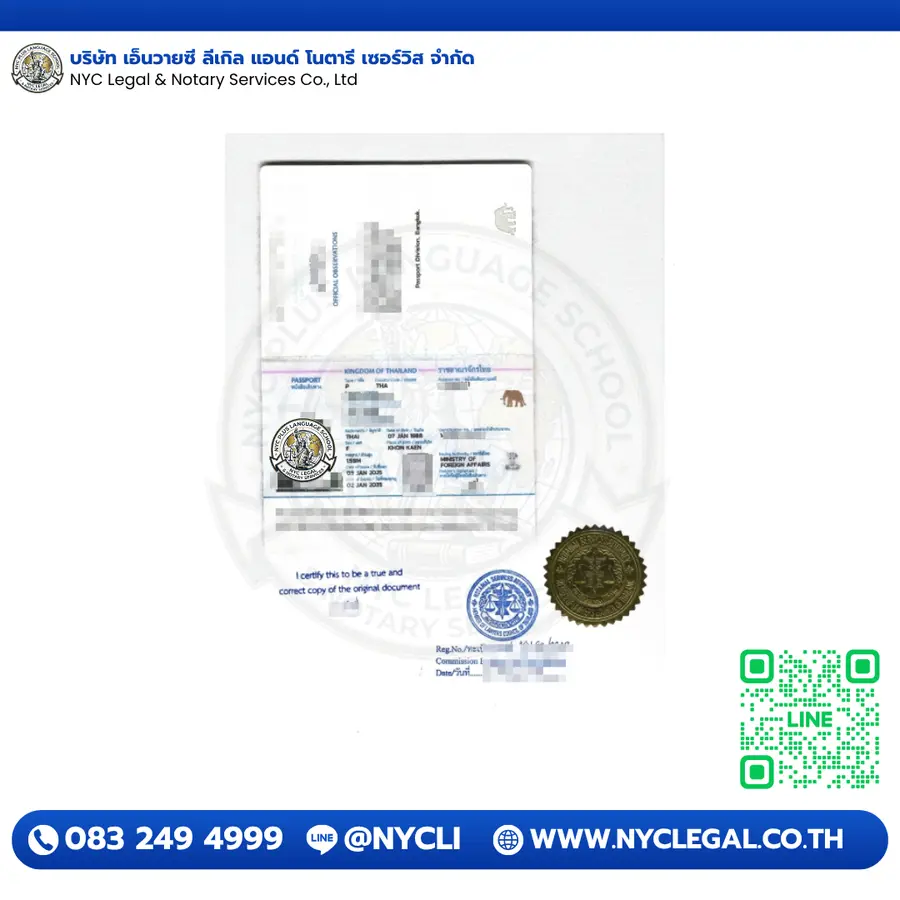
Sample visa application

40+ destinations

Worldwide

Turnaround

5–10 business days

Coverage

77 provinces

From

Request a quote

Free consultation before filing

Key takeaways

  • Outcomes rest solely with the deciding authority; no provider can promise a particular result
  • Foreign-language documents usually require translation and certification
  • Always check the official embassy or immigration website for current criteria
  • This page is general information, not case-specific legal advice

Additional frequently asked questions

Can documents be submitted in Thai?
Foreign embassies generally do not accept Thai-language documents without translation; a certified English translation, or one in that country's official language, must be attached in the prescribed format.
When can a refused application be resubmitted?
Usually as soon as the stated refusal ground is remedied, but read the decision letter carefully — some countries impose a waiting period or direct applicants to an appeal route instead.
What company documents are needed for business visas?
Typically a company affidavit, an invitation letter from the counterparty and an employment or position letter, each with translation and certification as the embassy requires. Scope and requirements are confirmed case by case by phone, LINE or email.
How far ahead should preparation start?
Several weeks before travel: issuing public records, translating and each certification layer all have their own queues, and some documents must be less than 3–6 months old on submission.
How must visa supporting documents be certified?
Most embassies require Thai public documents to be translated into English, the translation certified, and the set legalised by the Department of Consular Affairs before submission. Exact rules vary by country and visa class.
How many months of financial evidence are needed?
Embassies commonly ask for 3–6 months of statements plus a bank letter. Required balances and periods differ by destination and visa type, so rely on that embassy's current published checklist.

How this connects to the next step

Visa bundles are most often returned because supporting papers are uncertified: check the police clearance and how long it stays valid and prepare certified translations of financial and civil-registry records before the first submission.

In depth: the real requirements and why documents get rejectedVisa supporting documents

Written from the competent authority's published rules, not marketing copy.

Every immigration authority publishes its own document list, and that list varies by application type. Relying on a summary from a non-official source is the usual cause of an incomplete file.

Conditions you actually have to clear

  • Names across every document must match the passport; where an older document uses a former name, evidence of the change must be attached.
  • Financial evidence must be issued by the institution and show movement, not an application screenshot.
  • Relationship evidence such as a marriage certificate or birth certificate must be recently issued if the destination sets an age limit.

Common causes of rejection

  • Filing documents older than the destination's accepted age, which costs an assessment cycle.
  • Addresses that differ across documents without an accompanying explanation.

With a fixed travel date, plan backwards from the filing date and allow for issuing times at source, which no agent controls.

Key facts at a glanceEmbassy legalization

Indicative price
From Request a quote excluding embassy fees
Turnaround
5–15 business days depending on each embassy's policy
What you receive
Documents MFA-legalized then stamped by the destination embassy
Service coverage
Nationwide Thailand — courier and fully online intake, no in-person visit required.

Figures above are indicative ranges; the final quote depends on page count, language pair and receiving authority.

Ask us or request a quote right away

Documents you need to prepareEmbassy legalization

  1. 1Documents already legalized by the Thai Department of Consular Affairs
  2. 2The destination embassy's completed application form
  3. 3Valid original passport or Thai ID card of the person signing
  4. 4Current embassy fees, charged separately from our service fee

Before you start

  • Keep a copy of everything submitted in case the receiving authority requests further evidence later.
  • Tell us early if you need a rush job so we can reserve attorney time and the courier slot.

Practitioner guidanceEmbassy legalisation

Competent authority: The destination country's embassy or consulate

Practitioner guidance

  • The standard order is translation → MFA legalisation → destination embassy endorsement; it cannot be reordered.
  • Check copy counts, forms and booking methods directly with the embassy, as these vary widely.
  • Some countries have no mission in Thailand and are covered from a neighbouring country — allow for document transit.
  • Commercial documents usually need Board of Trade certification before the embassy stage.
  • Keep copies at every stage; originals stay with the authorities while in process.

Pitfalls — why documents get rejected

  • Sending documents abroad without trackable delivery.
  • Ignoring destination-country public holidays when planning.
  • Filing at the embassy before MFA legalisation.
  • Applying one embassy's requirements to another.
  • Commercial documents missing required chamber-of-commerce certification.

Official sources: consular.mfa.go.th/th/publicservice/legalization · www.hcch.net/en/instruments/conventions/status-table/?cid=41

General guidance only. Requirements and processing times change — always verify with the competent authority before filing.

Unsure which route applies to your case? Ask our staff directly.

In-depth questions and answersEmbassy legalisation

Answers follow the competent authority's published requirements, not marketing copy.

What deserves extra care when Embassy legalisation is filed with an overseas authority?

Observed cause: No prior appointment at an appointment-only mission. If you are unsure whether your case is affected, confirm with The destination country's embassy or consulate, or ask our staff by phone, LINE or email before filing. This is general guidance; requirements and processing times change — verify with the competent authority before filing.

Which Embassy legalisation error is hardest to correct afterwards?

Observed cause: Sending documents abroad without trackable delivery. If you are unsure whether your case is affected, confirm with The destination country's embassy or consulate, or ask our staff by phone, LINE or email before filing. This is general guidance; requirements and processing times change — verify with the competent authority before filing.

Which Embassy legalisation trap do applicants usually notice too late?

Observed cause: Ignoring destination-country public holidays when planning. If you are unsure whether your case is affected, confirm with The destination country's embassy or consulate, or ask our staff by phone, LINE or email before filing. This is general guidance; requirements and processing times change — verify with the competent authority before filing.

Which authority is competent for Embassy legalisation?

The destination country's embassy or consulate is the principal competent authority for Embassy legalisation. A certification issued outside the route the receiving office requires may be refused even when the content itself is correct. This is general guidance; requirements and processing times change — verify with the competent authority before filing.

Where can the current requirements for Embassy legalisation be verified?

Check the notices published by The destination country's embassy or consulate. The official sources used on this page are https://consular.mfa.go.th/th/publicservice/legalization · https://www.hcch.net/en/instruments/conventions/status-table/?cid=41. Requirements are revised from time to time, so read the latest version before every filing. This is general guidance; requirements and processing times change — verify with the competent authority before filing.

What if our Embassy legalisation case has unusual conditions?

For edge cases — mismatched names across documents, foreign-issued records, or a tight deadline — have the set reviewed first, then reconfirm the conditions with The destination country's embassy or consulate. Ask our staff by phone, LINE or email for scope and timing (we do not publish fees on the page because they depend on the document type and destination). This is general guidance; requirements and processing times change — verify with the competent authority before filing.

How long does Embassy legalisation take?

Turnaround is not fixed: it depends on the queue and rules of The destination country's embassy or consulate, the document type, and the receiving office abroad. For that reason we do not publish a fixed figure. Plan a buffer before your real deadline and ask our staff by phone, LINE or email for the current queue before booking travel. This is general guidance; requirements and processing times change — verify with the competent authority before filing.

Does the result of Embassy legalisation expire?

Validity is set by the receiving office, not by the service provider. Many offices accept only recently issued documents, so confirm the destination's window first and only then start the process with The destination country's embassy or consulate, to avoid the document expiring while it waits in the queue. This is general guidance; requirements and processing times change — verify with the competent authority before filing.

Your case may have specific conditions — ask our staff directly.

094-895-8999LINE @ThainotaryNotary@ilc.ltd

Official sources: consular.mfa.go.th · www.hcch.net

Continue with related services

The paths most clients take next — ask us by phone, LINE or email at any step.

Status of the Apostille Convention for Thailand (verified 30 July 2026)

Thailand deposited its instrument of accession to the 1961 Hague Apostille Convention on 30 June 2026, and the Convention enters into force for Thailand on 28 February 2027. Until that date, Thai documents used abroad still require legalisation by the Department of Consular Affairs (Ministry of Foreign Affairs) followed by legalisation at the destination country's embassy.

Today (before 28 February 2027) Thai documents used abroad still follow the existing chain: certified translation → notarial attestation → legalisation by the Department of Consular Affairs (MFA) → legalisation at the destination country's embassy in Thailand.

Once the Convention enters into force for Thailand on 28 February 2027, Thai public documents sent to any of the 130 Contracting Parties will require only a single Apostille from the Department of Consular Affairs, with no further embassy legalisation.

Source: HCCH (Hague Conference on Private International Law) Thailand accedes to the 1961 Apostille Convention

Verified professional credentials

  • Member, Lawyers Council of Thailand (สภาทนายความ) verify
  • Registered certified translator, Ministry of Justice (Thailand) verify
  • Recognized agent for MFA Legalization Division, Thailand verify

Consumer protection & guarantees

  • Acceptance-or-rework guarantee: we redo the work at no charge if the receiving authority rejects a first submission due to a fault on our side.
  • Transparent fees quoted in writing before any work begins — no hidden surcharges.
  • Confidentiality: documents handled under a written non-disclosure undertaking.
  • Direct human contact for questions and quotations by phone, LINE or email.

Read the full Privacy Policy and Terms of Service

Composite cases assembled from commonly seen matters — not individual clients, no personal data.

education documents from Lampang for an overseas estate matter

a Thai–foreign couple filing together from Lampang — the destination prescribed a specific translation and certifier type, so the right track had to be chosen upfront

What we handled: arranged the signing or lodgement appointment and listed what to bring · tracked progress between steps and reported status along the way · delivered a scanned set plus the originals with lodgement instructions · reviewed the source documents and flagged which ones needed re-issuing before work began

What clients usually ask in matters like this: are true originals required, or will certified copies do?

Indicative timeline: roughly 10–20 working days end to end

police clearance certificate from Switzerland for a residence-visa filing

an attorney-in-fact acting for the document holder from Switzerland — the signatory and the applicant were in different provinces, so signing and shipping had to be planned

What we handled: delivered a scanned set plus the originals with lodgement instructions · reviewed the source documents and flagged which ones needed re-issuing before work began · arranged the signing or lodgement appointment and listed what to bring

What clients usually ask in matters like this: how long does the set stay valid after certification?

Indicative timeline: roughly 10–20 working days end to end

civil registration documents from China for a foreign branch registration

an authorised representative of a Thai-registered company from China — a tight travel or filing deadline required resequencing the work

What we handled: tracked progress between steps and reported status along the way · prepared the translation and reconciled every name spelling against the passport · delivered a scanned set plus the originals with lodgement instructions

What clients usually ask in matters like this: who must certify the translation for it to be accepted at destination?

Indicative timeline: roughly 7–14 working days end to end

Browse every case for this serviceEmbassy legalisation

Primary sources from official authorities

The guidance on this page follows the rules published by the authorities below. Always confirm the current version on the official site before filing.