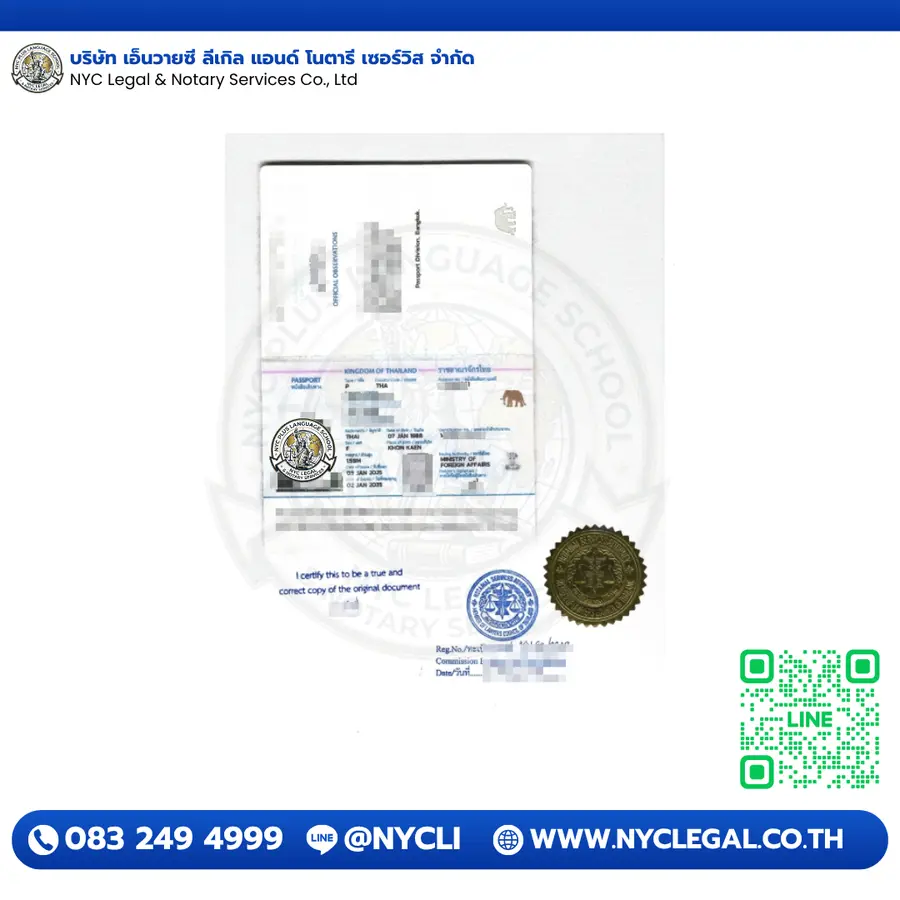
What legalization does Switzerland require?
Switzerland requires MFA legalization followed by attestation at the สถานทูตสวิส. Every document we ship carries the issuing authority's full stamp and signature, certified translation by an MFA-recognized translator, MFA consular legalization, and สถานทูตสวิส attestation when required.
Switzerland use cases commonly requiring MFA legalization
B Permit. These use cases require Thai public documents fully processed through the Legalization Chain. Our completed documents are ready to file immediately after all three layers of certification.
Apostille or Legalization Chain — what does Switzerland use?
Switzerland is a Hague Apostille Convention 1961 member, but Thailand is not — so Thai documents go through the Legalization Chain instead of receiving an Certificate authentication. Our Legalization Chain takes slightly longer than Apostille but delivers equivalent legal effect. We get every step right the first time so documents aren't rejected at destination.
Workflow for clients in Switzerland
(1) Sign and have the PoA legalized at the Thai consular post in Switzerland. (2) Ship originals and copies to our Thailand team. (3) We obtain origin-agency certified copies, translate, MFA-legalize, and สถานทูตสวิส-attest. (4) DHL/FedEx ships back to Switzerland in 7–15 days — total 15–30 days from dispatch.
Total cost shipping to Switzerland
Bundled cost shipping to Switzerland ranges THB 4,000–15,000 per document depending on document type, number of copies, translation language, and legalization level (MFA only vs. สถานทูตสวิส attestation). Postage ~ THB 2,500. Request a precise bundled quote anytime.
MFA online booking and express channels
MFA accepts translations from registered translators or recognized language conversion companies — list at consular.mfa.go.th. Translations must match the source verbatim including reference numbers, dates, signatures, and stamps. Common languages: English, French, German, Chinese, Japanese, Korean, Arabic, Spanish, Italian, Portuguese.
Certifying copies of Thai government documents for overseas use
Book online at qlegal.consular.go.th. Chaeng Watthana hours: Mon–Fri 08:30–14:30 for filing (overall service window 09:00–16:00). Closed weekends and public holidays. Regional branches with legalization service: Chiang Mai, Khon Kaen, Songkhla, and Phuket.
Chaeng Wattana headquarters vs regional MFA branches
After MFA, the final step is filing at the destination diplomatic mission in Bangkok. Each diplomatic mission has its own turnaround, fees, and requirements — typically 3–10 business days. Some embassies (China, Germany, France) require advance online appointments. Our team books the slot and submits on your behalf when embassy rules permit.
Resolving signature mismatches against the MFA database
Clients who cannot travel to MFA Chaeng Watthana can engage us under a Power of Attorney with THB 30 stamp duty, plus copies of both parties' Thai national IDs. We handle every step — filing, follow-up, document collection, and onward consulate submission.
MFA consular legalization process step by step
Common reasons for rejection or delay: missing origin-agency certification, translation not matching the source, unclear stamps/signatures, expired documents (e.g. Single Status past 6 months), or using a translator not on the MFA list. A pre-filing review with our team eliminates these risks.
Original documents and copies you need to prepare
Foreign nationals living in Thailand can use our MFA legalization service for personal documents created in Thailand — Thai marriage certificate to a Thai national, child birth certificate, Power of Attorney, Affidavit, etc. — before sending them home. Same workflow as Thai nationals, with passport and visa copies attached.