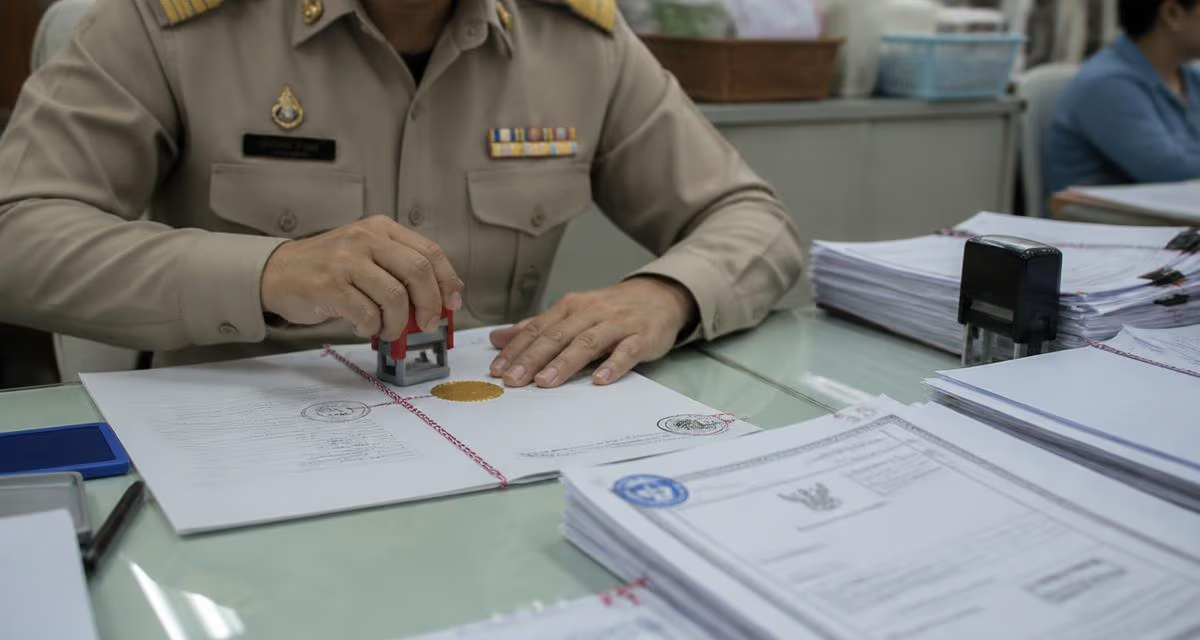
An apostille is the single-step Hague Convention legalization. Thailand is not a Hague apostille member, so consular legalization is used instead.
Key takeaways
Both the issuing and destination country must be parties to the Hague Convention
Private documents must first be certified by a Notarial Services Attorney
Thai-language documents usually require a certified translation before submission
Check current member status and requirements with HCCH and the Department of Consular Affairs
Process at a glance
Step
Performed by
Documents needed
Approximate time
1. Confirm the destination country is a Hague Convention party
Applicant (check HCCH status table)
Destination country + document type
approx. 1 day
2. Obtain the public document, or notarize a private one
Issuing agency or Notarial Services Attorney
Original or agency-certified copy
approx. 1–3 working days
3. Translate and certify the translation (Thai-language files)
Translator accepted by the receiving body
Original + passport copy
approx. 1–3 working days
4. File the Apostille request
Department of Consular Affairs, MFA
Complete file + application form
approx. 3–7 working days
Durations are estimates and depend on the responsible authority's queue. Always confirm current requirements with the receiving body before filing.
Real customer questions, answered by our attorneys
Selected from our knowledge base of 3,300+ real questions we have answered.
Living upcountry or overseas, how can legalising a foreign document for use inside Thailand be completed without travelling in person?
Consular / Apostille
Per the Legalization Division, Department of Consular Affairs (MFA Thailand) to "Living upcountry or overseas, how can legalising a foreign document for use inside Thailand be completed without travelling in person?" — Thai consular legalisation is performed by the Legalization Division, Department of Consular Affairs, Ministry of Foreign Affairs, at Government Complex Chaeng Watthana (Building B), plus MRT Khlong Toei and regional counters. Thailand deposited its instrument of accession to the Hague Apostille Convention on 30 June 2026, with entry into force for Thailand on 28 February 2027, so documents destined for member states now need a single Apostille from MFA — no destination-embassy step, except for states that objected to Thailand's accession. Send a photo of the document to LINE @Thainotary and we will quote the chain, cost and timeline before work begins.
Process in brief: (1) confirm the original was issued by the competent authority and is still within the accepted validity window; (2) have it translated by a translator the destination accepts; (3) obtain certification of the signature/translation; (4) add destination-embassy legalisation only where Apostille is not accepted; (5) proof names, dates and reference numbers before dispatch.
What to prepare: the original, the translation kept unbound from the source until certification, passport copies of every person named in the document, and any relationship evidence such as a house registration or marriage certificate if the destination asks for it.
Common pitfall: official fees and service windows change. Verify the current rate and turnaround directly with the certifying authority before you fix a budget or a travel date.
Practitioner's tip: treat the destination authority's own published checklist as the final reference; country-specific rules change, and we will review that checklist with you before filing.
Which translation format does the Immigration Bureau accept, and when is MFA legalisation of the translation mandatory rather than optional?
Certified translation
Per the Legalization Division, Department of Consular Affairs (MFA Thailand) to "Which translation format does the Immigration Bureau accept, and when is MFA legalisation of the translation mandatory rather than optional?" — Thailand deposited its instrument of accession to the Hague Apostille Convention on 30 June 2026, with entry into force for Thailand on 28 February 2027, so outbound documents to member states need one Apostille from MFA instead of a destination-embassy step, except for states that objected to the accession. We cover English, Chinese (Simplified/Traditional), Japanese, Korean, German, French, Spanish, Portuguese, Russian, Italian, Arabic, Persian, Turkish, Hindi, Vietnamese, Myanmar, Lao, Khmer, Indonesian, Malay, Tagalog, Dutch, Swedish, Danish, Finnish and Eastern European languages. Door-to-door pickup in Bangkok and DHL dispatch worldwide — call 094-895-8999.
Process in brief: (1) tell us the destination country and purpose so the correct chain is set from day one; (2) re-issue the original if it is older than the destination's limit; (3) translate and proofread twice against the source; (4) certify in the correct order; (5) return the sealed set with a digital copy for your records.
What to prepare: an intact original that is not torn or laminated, evidence of any name change where the document does not match your current name, a passport copy, and a power of attorney with ID copies of both grantor and agent.
Common pitfall: states that objected to Thailand's accession to the Apostille Convention still require destination-embassy legalisation, so confirm the destination's position before starting.
Practitioner's tip: treat the destination authority's own published checklist as the final reference; country-specific rules change, and we will review that checklist with you before filing.
How is a public document issued in France certified and translated before it can be filed with a Thai district office, the DBD or a Thai court?
Consular / Apostille
Practitioner's view to "How is a public document issued in France certified and translated before it can be filed with a Thai district office, the DBD or a Thai court?" — Thailand deposited its instrument of accession to the Hague Apostille Convention on 30 June 2026, with entry into force for Thailand on 28 February 2027, so documents destined for member states now need a single Apostille from MFA — no destination-embassy step, except for states that objected to Thailand's accession. You never need to attend Chaeng Watthana yourself — we file under a power of attorney, track the queue, and courier the sealed originals back by EMS or DHL worldwide. Free consultation on LINE @Thainotary or call 094-895-8999 (Mon–Sun 08:00–20:00 ICT).
Process in brief: (1) tell us the destination country and purpose so the correct chain is set from day one; (2) re-issue the original if it is older than the destination's limit; (3) translate and proofread twice against the source; (4) certify in the correct order; (5) return the sealed set with a digital copy for your records.
What to prepare: the full original set, colour scans of every page for translation proofing, an English spelling list for all people and place names, and any extra items listed on the destination authority's own checklist.
Common pitfall: never unstaple or re-bind a certified set. Removing the staple is treated as breaking the seal and the destination may reject the whole file; photocopy without dismantling it.
Practitioner's tip: treat the destination authority's own published checklist as the final reference; country-specific rules change, and we will review that checklist with you before filing.
Is Singapore a party to the Hague Apostille Convention, and how does that change the route for a Thai-issued document?
Notary Public
Per the Lawyers Council of Thailand's Notarial Services rules to "Is Singapore a party to the Hague Apostille Convention, and how does that change the route for a Thai-issued document?" — Standard turnaround is 1 business day; same-day service is available by appointment for straightforward files. You must sign in front of the attorney with your original passport; the attorney affixes the notarial seal, signature, register number and date so the document is accepted abroad. Send a photo of your document to LINE @Thainotary and we'll quote and schedule before work begins.
Process in brief: (1) tell us the destination country and purpose so the correct chain is set from day one; (2) re-issue the original if it is older than the destination's limit; (3) translate and proofread twice against the source; (4) certify in the correct order; (5) return the sealed set with a digital copy for your records.
What to prepare: an intact original that is not torn or laminated, evidence of any name change where the document does not match your current name, a passport copy, and a power of attorney with ID copies of both grantor and agent.
Common pitfall: the single largest cause of rejection is an English spelling that does not match the passport. Always take the passport spelling as authoritative and confirm it before translation starts.
Practitioner's tip: if the same document is needed by several authorities, produce all copies in one round — it saves time and keeps the certification format consistent across the sets.
Do documents bearing an official Apostille stamp require secondary legalization by the Thai MFA?
Consular / Apostille
Practitioner's view to "Do documents bearing an official Apostille stamp require secondary legalization by the Thai MFA?" — Thailand deposited its instrument of accession to the Hague Apostille Convention on 30 June 2026, with entry into force for Thailand on 28 February 2027, so documents destined for member states now need a single Apostille from MFA — no destination-embassy step, except for states that objected to Thailand's accession. You never need to attend Chaeng Watthana yourself — we file under a power of attorney, track the queue, and courier the sealed originals back by EMS or DHL worldwide. Send a photo of the document to LINE @Thainotary and we will quote the chain, cost and timeline before work begins.
Process in brief: (1) confirm whether the receiving body wants an Apostille or embassy legalisation; (2) obtain the certified original from the issuing authority; (3) translate through an accepted translator; (4) certify translation and signature; (5) keep high-resolution colour scans of every page before the file leaves Thailand.
What to prepare: the original or a certified extract from the issuing authority, a copy of the holder's ID or passport, a power of attorney if someone files on your behalf, and the exact English spelling of every name as it appears in the passport.
Common pitfall: self-made or machine translations are usually refused — reviewers check the letterhead, the translator's certification wording, and whether every stamp on the original has been rendered.
Practitioner's tip: treat the destination authority's own published checklist as the final reference; country-specific rules change, and we will review that checklist with you before filing.
What healing arts rules govern alternative medicine practice license translations?
Certified translation
Short answer to "What healing arts rules govern alternative medicine practice license translations?" — MFA Thailand only certifies the Thai–English pair, so a third-language original is either relayed through English or translated directly into Thai with a signed translator declaration attached to every page. Thailand deposited its instrument of accession to the Hague Apostille Convention on 30 June 2026, with entry into force for Thailand on 28 February 2027, so outbound documents to member states need one Apostille from MFA instead of a destination-embassy step, except for states that objected to the accession. Free consultation on LINE @Thainotary or call 094-895-8999 (Mon–Sun 08:00–20:00 ICT).
Process in brief: (1) confirm the original was issued by the competent authority and is still within the accepted validity window; (2) have it translated by a translator the destination accepts; (3) obtain certification of the signature/translation; (4) add destination-embassy legalisation only where Apostille is not accepted; (5) proof names, dates and reference numbers before dispatch.
What to prepare: the full original set, colour scans of every page for translation proofing, an English spelling list for all people and place names, and any extra items listed on the destination authority's own checklist.
Common pitfall: never unstaple or re-bind a certified set. Removing the staple is treated as breaking the seal and the destination may reject the whole file; photocopy without dismantling it.
Practitioner's tip: if the same document is needed by several authorities, produce all copies in one round — it saves time and keeps the certification format consistent across the sets.
For a Arabic-language original, does the Department of Consular Affairs certify the translation directly, or must it be routed through an English or Thai version first?
Certified translation
Practitioner's view to "For a Arabic-language original, does the Department of Consular Affairs certify the translation directly, or must it be routed through an English or Thai version first?" — MFA Thailand only certifies the Thai–English pair, so a third-language original is either relayed through English or translated directly into Thai with a signed translator declaration attached to every page. Thailand deposited its instrument of accession to the Hague Apostille Convention on 30 June 2026, with entry into force for Thailand on 28 February 2027, so outbound documents to member states need one Apostille from MFA instead of a destination-embassy step, except for states that objected to the accession. Door-to-door pickup in Bangkok and DHL dispatch worldwide — call 094-895-8999.
Process in brief: (1) confirm the original was issued by the competent authority and is still within the accepted validity window; (2) have it translated by a translator the destination accepts; (3) obtain certification of the signature/translation; (4) add destination-embassy legalisation only where Apostille is not accepted; (5) proof names, dates and reference numbers before dispatch.
What to prepare: the full original set, colour scans of every page for translation proofing, an English spelling list for all people and place names, and any extra items listed on the destination authority's own checklist.
Common pitfall: many destinations accept documents only within 3–6 months of issue or certification. Missing that window means re-issuing and re-certifying the entire set, so plan backwards from the real filing date.
Practitioner's tip: if the same document is needed by several authorities, produce all copies in one round — it saves time and keeps the certification format consistent across the sets.
What is the safest way to courier the legalised adoption papers and family-court orders abroad, and how is a replacement obtained if it is lost in transit?
Consular / Apostille
Quick summary for expats, HR and law firms to "What is the safest way to courier the legalised adoption papers and family-court orders abroad, and how is a replacement obtained if it is lost in transit?" — Thai consular legalisation is performed by the Legalization Division, Department of Consular Affairs, Ministry of Foreign Affairs, at Government Complex Chaeng Watthana (Building B), plus MRT Khlong Toei and regional counters. Thailand deposited its instrument of accession to the Hague Apostille Convention on 30 June 2026, with entry into force for Thailand on 28 February 2027, so documents destined for member states now need a single Apostille from MFA — no destination-embassy step, except for states that objected to Thailand's accession. Send a photo of the document to LINE @Thainotary and we will quote the chain, cost and timeline before work begins.
Process in brief: (1) confirm whether the receiving body wants an Apostille or embassy legalisation; (2) obtain the certified original from the issuing authority; (3) translate through an accepted translator; (4) certify translation and signature; (5) keep high-resolution colour scans of every page before the file leaves Thailand.
What to prepare: the original, the translation kept unbound from the source until certification, passport copies of every person named in the document, and any relationship evidence such as a house registration or marriage certificate if the destination asks for it.
Common pitfall: the single largest cause of rejection is an English spelling that does not match the passport. Always take the passport spelling as authoritative and confirm it before translation starts.
Practitioner's tip: send us photographs of the documents before work begins. We will confirm the correct chain, an honest timeline, and anything still missing so you do not lose a filing slot.
Composite cases similar to this page — Apostille certification
Composite cases assembled from commonly seen matters — not individual clients, no personal data.
police clearance certificate from Surat Thani for a residence application
an attorney-in-fact acting for the document holder from Surat Thani — the destination prescribed a specific translation and certifier type, so the right track had to be chosen upfront
What we handled: arranged the signing or lodgement appointment and listed what to bring · reviewed the source documents and flagged which ones needed re-issuing before work began
What clients usually ask in matters like this: how long does the set stay valid after certification?
Indicative timeline: roughly 5–10 working days end to end
medical documents from Nakhon Sawan for use in a Hague Convention state
a Thai–foreign couple filing together from Nakhon Sawan — the signatory and the applicant were in different provinces, so signing and shipping had to be planned
What we handled: delivered a scanned set plus the originals with lodgement instructions · tracked progress between steps and reported status along the way · prepared the translation and reconciled every name spelling against the passport · sequenced the certification chain to match the destination authority's rules
What clients usually ask in matters like this: are true originals required, or will certified copies do?
Indicative timeline: roughly 5–10 working days end to end
medical documents from Nonthaburi for a citizenship application
a foreign national living in Thailand from Nonthaburi — the spelling on older documents did not match the current passport
What we handled: reviewed the source documents and flagged which ones needed re-issuing before work began · prepared the translation and reconciled every name spelling against the passport · delivered a scanned set plus the originals with lodgement instructions
What clients usually ask in matters like this: if I am upcountry or abroad, must I attend in person?
Indicative timeline: roughly 3–7 working days end to end