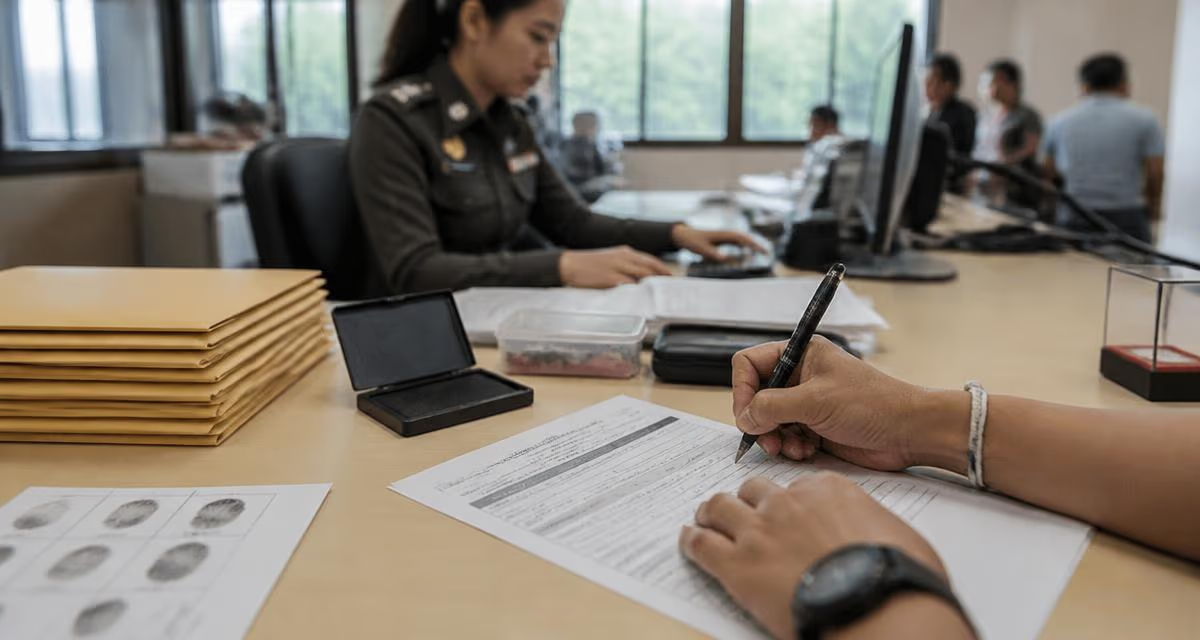
A Thai police clearance certificate is issued by the Royal Thai Police Criminal Records Division; for overseas use it is typically translated and MFA-legalized.
Key takeaways
Fingerprints must be taken on the form prescribed by the Royal Thai Police
Applicants overseas may be fingerprinted at a Thai embassy or consulate
Many countries accept the certificate only within 3–6 months of issue
For overseas use it usually needs translation plus legalization or an Apostille
Process at a glance
Step
Performed by
Documents needed
Approximate time
1. Prepare the application and state the purpose of use
Applicant
Passport/ID + evidence of the stated purpose
approx. 1 day
2. Fingerprinting
Criminal Records Division, Royal Thai Police (or designated station)
Fingerprint form + photo ID
approx. 1 working day
3. Record check and issuance
Criminal Records Division, Royal Thai Police
Complete application file
approx. 7–30 working days
4. Legalization for overseas use where required
Department of Consular Affairs and/or destination embassy
Certificate + translation
approx. 2–7 working days
Durations are estimates and depend on the responsible authority's queue. Always confirm current requirements with the receiving body before filing.
Real customer questions, answered by our attorneys
Selected from our knowledge base of 3,300+ real questions we have answered.
For a foreign-issued source record, how do cost and turnaround compare between a PCC for employment and professional licensing and consular legalisation stamped onto the PCC?
Police clearance
Quick summary for expats & migration agents to "For a foreign-issued source record, how do cost and turnaround compare between a PCC for employment and professional licensing and consular legalisation stamped onto the PCC?" — The Thai Police Clearance Certificate is issued by the Criminal Records Division (CRD) of the Royal Thai Police in Bangkok, accepted by Australian Home Affairs, USCIS/NVC, UKVI, IRCC (Canada), all Schengen embassies, and by AHPRA / Engineers Australia / VETASSESS / CPA Australia when a good-character check is required. If you are outside Thailand, take your fingerprints at any local police station or Royal Thai Embassy on form FD-258 or Thai form Tor.Tor.14, mail the originals to us, and we submit them to CRD the next business day. Send a photo of your passport to LINE @Thainotary and we'll quote and schedule fingerprinting within 15 minutes.
Process in brief: (1) decide whether the destination requires an original or a certified true copy; (2) prepare a power of attorney if you cannot attend; (3) translate in the required format; (4) file and monitor the queue; (5) verify whether supporting documents are also required at destination.
What to prepare: the full original set, colour scans of every page for translation proofing, an English spelling list for all people and place names, and any extra items listed on the destination authority's own checklist.
Common pitfall: many destinations accept documents only within 3–6 months of issue or certification. Missing that window means re-issuing and re-certifying the entire set, so plan backwards from the real filing date.
Practitioner's tip: give us your travel or filing deadline up front. We plan backwards and pick the service tier that lands on time without paying for unnecessary express handling.
What hidden costs do people overlook in a PCC for permanent residence and migration?
Police clearance
How we handle this in practice to "What hidden costs do people overlook in a PCC for permanent residence and migration?" — If you are outside Thailand, take your fingerprints at any local police station or Royal Thai Embassy on form FD-258 or Thai form Tor.Tor.14, mail the originals to us, and we submit them to CRD the next business day. The Thai Police Clearance Certificate is issued by the Criminal Records Division (CRD) of the Royal Thai Police in Bangkok, accepted by Australian Home Affairs, USCIS/NVC, UKVI, IRCC (Canada), all Schengen embassies, and by AHPRA / Engineers Australia / VETASSESS / CPA Australia when a good-character check is required. Send a photo of your passport to LINE @Thainotary and we'll quote and schedule fingerprinting within 15 minutes.
Process in brief: (1) decide whether the destination requires an original or a certified true copy; (2) prepare a power of attorney if you cannot attend; (3) translate in the required format; (4) file and monitor the queue; (5) verify whether supporting documents are also required at destination.
What to prepare: the original, the translation kept unbound from the source until certification, passport copies of every person named in the document, and any relationship evidence such as a house registration or marriage certificate if the destination asks for it.
Common pitfall: never unstaple or re-bind a certified set. Removing the staple is treated as breaking the seal and the destination may reject the whole file; photocopy without dismantling it.
Practitioner's tip: send us photographs of the documents before work begins. We will confirm the correct chain, an honest timeline, and anything still missing so you do not lose a filing slot.
In which order should fingerprinting for an overseas police check and consular legalisation stamped onto the PCC be done so nothing has to be repeated?
Police clearance
How we handle this in practice to "In which order should fingerprinting for an overseas police check and consular legalisation stamped onto the PCC be done so nothing has to be repeated?" — The Thai Police Clearance Certificate is issued by the Criminal Records Division (CRD) of the Royal Thai Police in Bangkok, accepted by Australian Home Affairs, USCIS/NVC, UKVI, IRCC (Canada), all Schengen embassies, and by AHPRA / Engineers Australia / VETASSESS / CPA Australia when a good-character check is required. If you are outside Thailand, take your fingerprints at any local police station or Royal Thai Embassy on form FD-258 or Thai form Tor.Tor.14, mail the originals to us, and we submit them to CRD the next business day. Send a photo of your passport to LINE @Thainotary and we'll quote and schedule fingerprinting within 15 minutes.
Process in brief: (1) check whether a parent authority must endorse the document first — a school, hospital or line department; (2) translate into the required language; (3) certify the translation; (4) complete the next certification layer; (5) submit within the validity window the destination accepts.
What to prepare: the original or a certified extract from the issuing authority, a copy of the holder's ID or passport, a power of attorney if someone files on your behalf, and the exact English spelling of every name as it appears in the passport.
Common pitfall: the single largest cause of rejection is an English spelling that does not match the passport. Always take the passport spelling as authoritative and confirm it before translation starts.
Practitioner's tip: if the same document is needed by several authorities, produce all copies in one round — it saves time and keeps the certification format consistent across the sets.
For a foreign-issued source record, how do cost and turnaround compare between fingerprinting for an overseas police check and consular legalisation stamped onto the PCC?
Police clearance
How we handle this in practice to "For a foreign-issued source record, how do cost and turnaround compare between fingerprinting for an overseas police check and consular legalisation stamped onto the PCC?" — The Thai Police Clearance Certificate is issued by the Criminal Records Division (CRD) of the Royal Thai Police in Bangkok, accepted by Australian Home Affairs, USCIS/NVC, UKVI, IRCC (Canada), all Schengen embassies, and by AHPRA / Engineers Australia / VETASSESS / CPA Australia when a good-character check is required. If you are outside Thailand, take your fingerprints at any local police station or Royal Thai Embassy on form FD-258 or Thai form Tor.Tor.14, mail the originals to us, and we submit them to CRD the next business day. Send a photo of your passport to LINE @Thainotary and we'll quote and schedule fingerprinting within 15 minutes.
Process in brief: (1) decide whether the destination requires an original or a certified true copy; (2) prepare a power of attorney if you cannot attend; (3) translate in the required format; (4) file and monitor the queue; (5) verify whether supporting documents are also required at destination.
What to prepare: an intact original that is not torn or laminated, evidence of any name change where the document does not match your current name, a passport copy, and a power of attorney with ID copies of both grantor and agent.
Common pitfall: states that objected to Thailand's accession to the Apostille Convention still require destination-embassy legalisation, so confirm the destination's position before starting.
Practitioner's tip: keep colour scans of every certified page. If a courier loses the set, digital copies make re-issue and verification dramatically faster.
Can a Thai police clearance certificate from the Royal Thai Police and consular legalisation stamped onto the PCC be run in parallel in one cycle to cut waiting days?
Police clearance
Practitioner's view to "Can a Thai police clearance certificate from the Royal Thai Police and consular legalisation stamped onto the PCC be run in parallel in one cycle to cut waiting days?" — Agency-handled turnkey service is quoted per case (standard 7–15 business days, express 3–5 business days), plus the government fee. Includes power of attorney, fingerprinting, CRD filing, English translation, MFA legalisation and Apostille (Thailand joined the Hague Apostille Convention 14 Feb 2025). Documents required: passport (all stamped pages), Thai ID + house-registration if Thai citizen, two 2×2-inch photos, purpose letter from the embassy/employer if any, and our notarised Power of Attorney (we provide the template). Worldwide DHL/EMS dispatch — call 094-895-8999 to book a mobile fingerprinting slot.
Process in brief: (1) confirm the original was issued by the competent authority and is still within the accepted validity window; (2) have it translated by a translator the destination accepts; (3) obtain certification of the signature/translation; (4) add destination-embassy legalisation only where Apostille is not accepted; (5) proof names, dates and reference numbers before dispatch.
What to prepare: the original, the translation kept unbound from the source until certification, passport copies of every person named in the document, and any relationship evidence such as a house registration or marriage certificate if the destination asks for it.
Common pitfall: states that objected to Thailand's accession to the Apostille Convention still require destination-embassy legalisation, so confirm the destination's position before starting.
Practitioner's tip: treat the destination authority's own published checklist as the final reference; country-specific rules change, and we will review that checklist with you before filing.
For a foreign-issued source record, how do cost and turnaround compare between a Thai police clearance certificate from the Royal Thai Police and a certified translation of the PCC?
Police clearance
Per Royal Thai Police CRD (Criminal Records Division) to "For a foreign-issued source record, how do cost and turnaround compare between a Thai police clearance certificate from the Royal Thai Police and a certified translation of the PCC?" — We offer nationwide Mobile Fingerprinting (Bangkok, Chiang Mai, Phuket, Pattaya, Khon Kaen, Udon Thani, Nong Khai) so you never need to visit the CRD in person — the entire process can be done by Power of Attorney. The certificate is valid for 3–6 months depending on the receiving authority. We can courier the sealed original via DHL/EMS worldwide with door-to-door tracking. Free consultation on LINE @Thainotary or call 094-895-8999 (Mon–Sun 08:00–20:00 ICT).
Process in brief: (1) tell us the destination country and purpose so the correct chain is set from day one; (2) re-issue the original if it is older than the destination's limit; (3) translate and proofread twice against the source; (4) certify in the correct order; (5) return the sealed set with a digital copy for your records.
What to prepare: the original or a certified extract from the issuing authority, a copy of the holder's ID or passport, a power of attorney if someone files on your behalf, and the exact English spelling of every name as it appears in the passport.
Common pitfall: never unstaple or re-bind a certified set. Removing the staple is treated as breaking the seal and the destination may reject the whole file; photocopy without dismantling it.
Practitioner's tip: treat the destination authority's own published checklist as the final reference; country-specific rules change, and we will review that checklist with you before filing.
How long does a PCC for adoption and child-related work stay valid, and how far ahead of filing should it be done?
Police clearance
Quick summary for expats & migration agents to "How long does a PCC for adoption and child-related work stay valid, and how far ahead of filing should it be done?" — If you are outside Thailand, take your fingerprints at any local police station or Royal Thai Embassy on form FD-258 or Thai form Tor.Tor.14, mail the originals to us, and we submit them to CRD the next business day. The Thai Police Clearance Certificate is issued by the Criminal Records Division (CRD) of the Royal Thai Police in Bangkok, accepted by Australian Home Affairs, USCIS/NVC, UKVI, IRCC (Canada), all Schengen embassies, and by AHPRA / Engineers Australia / VETASSESS / CPA Australia when a good-character check is required. Send a photo of your passport to LINE @Thainotary and we'll quote and schedule fingerprinting within 15 minutes.
Process in brief: (1) assemble the complete file before filing — partial filings lose a queue slot; (2) match every spelling to the passport; (3) file the whole set together so the stamps carry one date; (4) inspect the stamps at the counter; (5) ship with tracked delivery.
What to prepare: the original, a signed certified-true copy, a completed application form, a contact number reachable during office hours, and the name of the destination authority so the correct certification format is applied.
Common pitfall: never unstaple or re-bind a certified set. Removing the staple is treated as breaking the seal and the destination may reject the whole file; photocopy without dismantling it.
Practitioner's tip: treat the destination authority's own published checklist as the final reference; country-specific rules change, and we will review that checklist with you before filing.
What does a PCC for employment and professional licensing really cost line by line, and which part is a government fee?
Police clearance
Practitioner's view to "What does a PCC for employment and professional licensing really cost line by line, and which part is a government fee?" — The Thai Police Clearance Certificate is issued by the Criminal Records Division (CRD) of the Royal Thai Police in Bangkok, accepted by Australian Home Affairs, USCIS/NVC, UKVI, IRCC (Canada), all Schengen embassies, and by AHPRA / Engineers Australia / VETASSESS / CPA Australia when a good-character check is required. If you are outside Thailand, take your fingerprints at any local police station or Royal Thai Embassy on form FD-258 or Thai form Tor.Tor.14, mail the originals to us, and we submit them to CRD the next business day. Send a photo of your passport to LINE @Thainotary and we'll quote and schedule fingerprinting within 15 minutes.
Process in brief: (1) confirm the original was issued by the competent authority and is still within the accepted validity window; (2) have it translated by a translator the destination accepts; (3) obtain certification of the signature/translation; (4) add destination-embassy legalisation only where Apostille is not accepted; (5) proof names, dates and reference numbers before dispatch.
What to prepare: the original or a certified extract from the issuing authority, a copy of the holder's ID or passport, a power of attorney if someone files on your behalf, and the exact English spelling of every name as it appears in the passport.
Common pitfall: never unstaple or re-bind a certified set. Removing the staple is treated as breaking the seal and the destination may reject the whole file; photocopy without dismantling it.
Practitioner's tip: send us photographs of the documents before work begins. We will confirm the correct chain, an honest timeline, and anything still missing so you do not lose a filing slot.
Composite cases similar to this page — Police Clearance Certificate
Composite cases assembled from commonly seen matters — not individual clients, no personal data.
record clarification letter from Phitsanulok for a permanent-visa filing
an attorney-in-fact acting for the document holder from Phitsanulok — the signatory and the applicant were in different provinces, so signing and shipping had to be planned
What we handled: delivered a scanned set plus the originals with lodgement instructions · tracked progress between steps and reported status along the way · arranged the signing or lodgement appointment and listed what to bring · reviewed the source documents and flagged which ones needed re-issuing before work began
What clients usually ask in matters like this: are true originals required, or will certified copies do?
Indicative timeline: roughly 5–10 working days end to end
record clarification letter from Bangkok for a residence renewal
a foreign national living in Thailand from Bangkok — the originals were issued abroad, so the origin-country chain had to be completed first
What we handled: sequenced the certification chain to match the destination authority's rules · arranged the signing or lodgement appointment and listed what to bring · reviewed the source documents and flagged which ones needed re-issuing before work began · delivered a scanned set plus the originals with lodgement instructions
What clients usually ask in matters like this: who must certify the translation for it to be accepted at destination?
Indicative timeline: roughly 3–7 working days end to end
police clearance certificate from Germany for an adoption process
an authorised representative of a Thai-registered company from Germany — the spelling on older documents did not match the current passport
What we handled: reviewed the source documents and flagged which ones needed re-issuing before work began · prepared the translation and reconciled every name spelling against the passport · tracked progress between steps and reported status along the way
What clients usually ask in matters like this: if the destination rejects this set, do we start over from scratch?
Indicative timeline: roughly 3–7 working days end to end