Original and controlled-copy handling
Embassy authentication is the last link in the chain. We hold standing slots at 35 major Bangkok embassies, cutting the 5–10 day queue down to 2–3 business days. Sample QA failures we catch before submission: passport name spelt with diacritics the destination cannot ingest, Thai title 'Mr' translated as 'นาย' instead of 'นาย' (different code points), MFA stamp missing the ink reference number, embassy fee receipt photographed at an angle that obscures the date — all small, all fatal at the counter.
Documents and information you need to prepare
Clients access an online portal to view case timelines, download past deliverables, request requotes, and pull receipts going back five years — all encrypted and 2FA-gated. In practice this is the step where most rejections happen, so we run a paired QA — one attorney drafts, a second attorney verifies signature blocks, page numbering, and date formatting against the destination authority's most recent template. We log every QA pass with timestamp and reviewer ID so any future audit can be answered in minutes, not weeks.
Common mistakes and how to avoid them
Each destination has its own quirks: the US wants state-level Apostille, the UK uses FCDO Apostille, Australia accepts NAATI without Apostille, China requires embassy authentication, Japan often demands embassy-aligned translation. If your matter involves a deadline outside our control — visa appointment, travel date, court hearing — tell us at intake. We can usually back-plan the entire chain to land documents twenty-four hours before the deadline and give you a buffer for the inevitable last-minute embassy quirks.
Notes for corporate and institutional clients
We offer a written accuracy guarantee. If the destination authority rejects a document due to our error, we redo it for free and refund the MFA / embassy fee. Combined team experience exceeds 50 years. Foreign clients regularly ask whether they need a Thai national co-signer for any of these workflows. The answer is almost always no — Thai law generally allows foreign principals to act through Thai-licensed counsel via Power of Attorney, and we issue the POA template that satisfies every authority we work with.
Document risk assessment criteria
Our workflow: (1) free consultation via LINE / phone to confirm scope, (2) quote and deadline, (3) document intake, (4) production by licensed staff, (5) two-pass QA, (6) delivery and tax invoice. Clients track status 24/7 via reference number. Many destinations now require apostille in addition to translation since Thailand joined the Hague Convention on 14 December 2024. We handle the entire post-Hague workflow, including the cases where an embassy still asks for the legacy MFA + embassy chain because their own implementation has not caught up.
Coordination with government agencies
The intake team uses service-specific checklists refreshed quarterly against the latest destination-authority requirements, keeping rework rates below 0.5%. Cost ranges in this guide are inclusive: government fees, courier, translation, certification, and our service fee. The single line item that can vary is destination-embassy fees, which several embassies adjust quarterly without notice; when they do, we absorb the variance for any quote already sent.
Payment and tax invoice
We staff by language pair: Chinese–Thai, Japanese–Thai, Korean–Thai, Arabic–Thai, and Romance languages, with a Senior Editor reviewing every file before delivery. Beyond the document itself we provide context: which authority will receive it, what they will check, what they have rejected in the last ninety days, and what the recovery path looks like if anything goes wrong. That context is included in every engagement, not sold separately, because we believe informed clients make better filings.
Post-delivery follow-up
For multi-document engagements (M&A diligence, licensing applications) a Project Manager owns the file end-to-end with Gantt scheduling, weekly status reports, and full agency coordination. We routinely handle files for clients who never set foot in Thailand. The Remote POA workflow — notary in your country, Apostille, courier to us — lets us act on your behalf for the entire Thai-side chain. Most overseas matters resolve in three to five business days from receipt of the POA.
Workflow from intake to delivery
Each file is scored on four risk axes before intake: content complexity, urgency, destination-authority complexity, and terminology risk — so the right team and timeline can be assigned. For complex chains — translation + lawyer certification + MFA + destination embassy + courier — we prefer one engagement, one project manager, one invoice. Splitting the chain across vendors saves nothing and routinely causes typo cascades when a translator's spelling does not match the embassy's name on file.
The team behind your file and their credentials
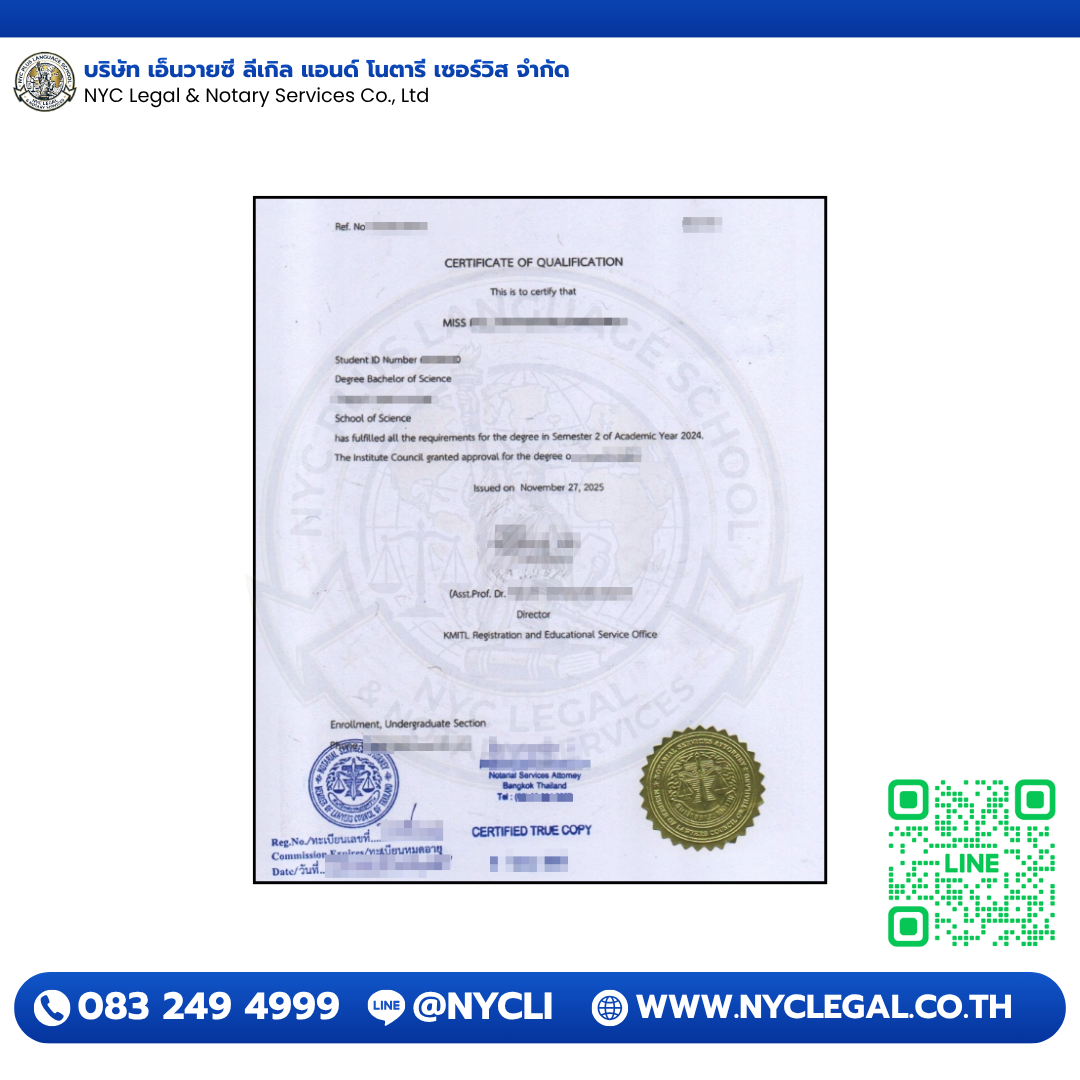
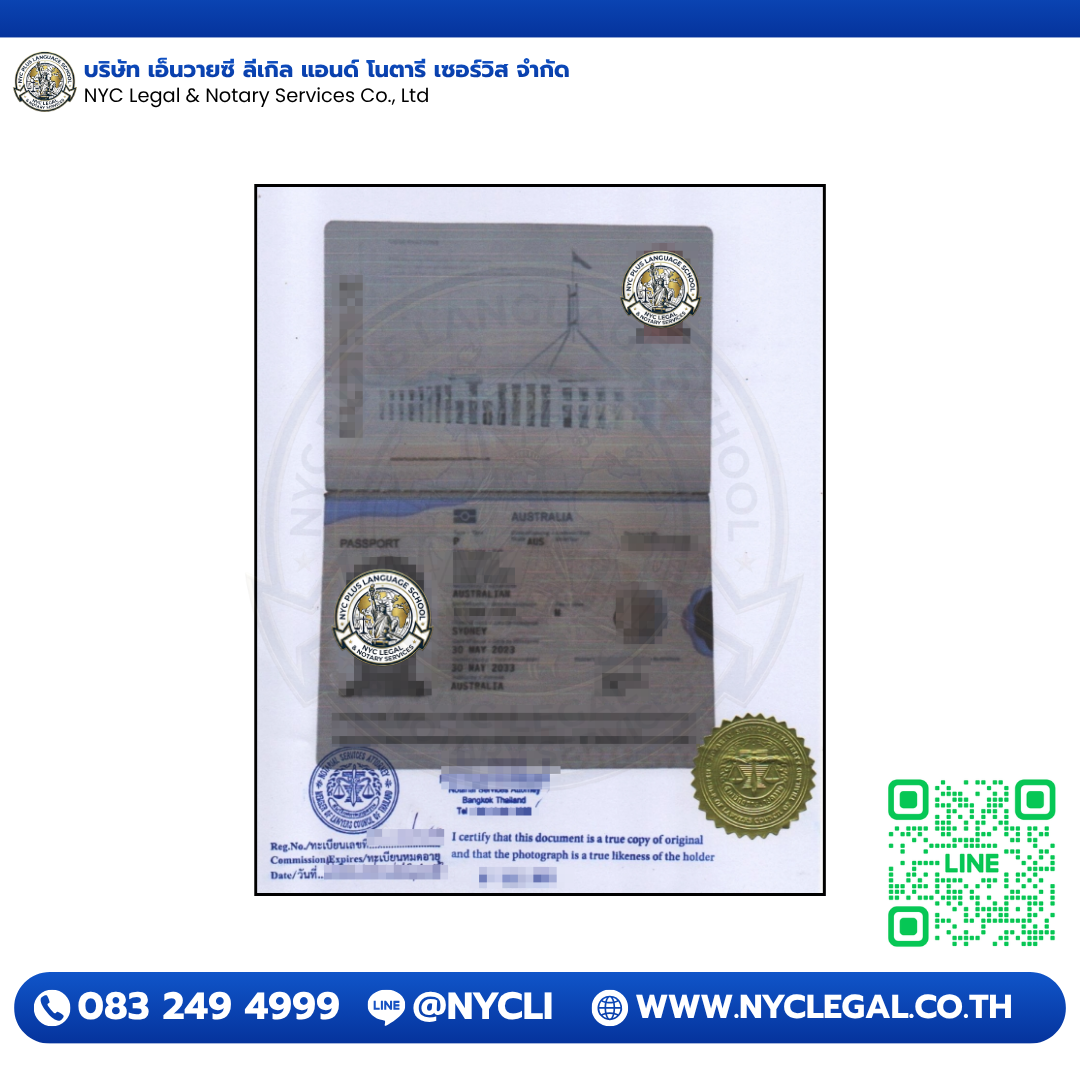
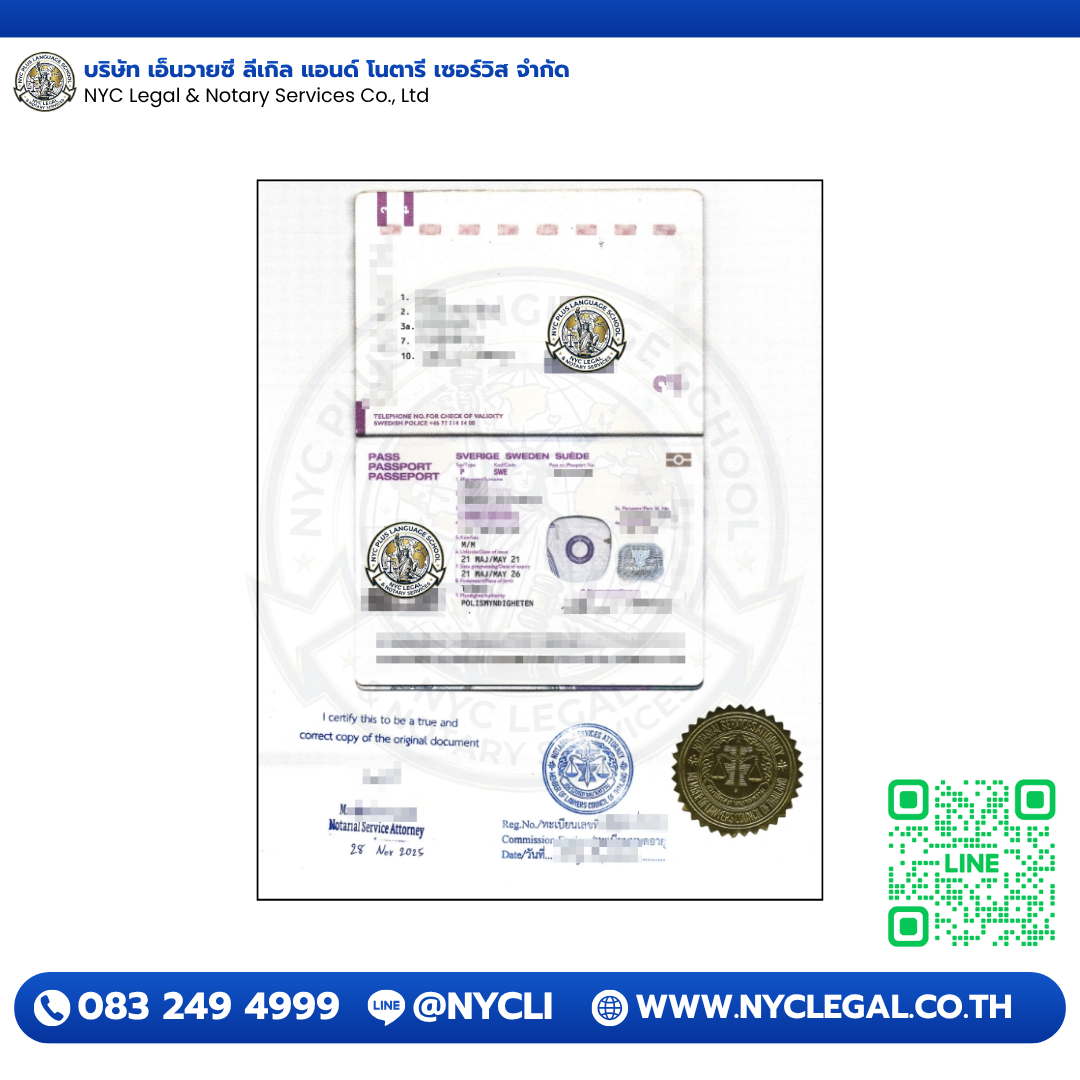
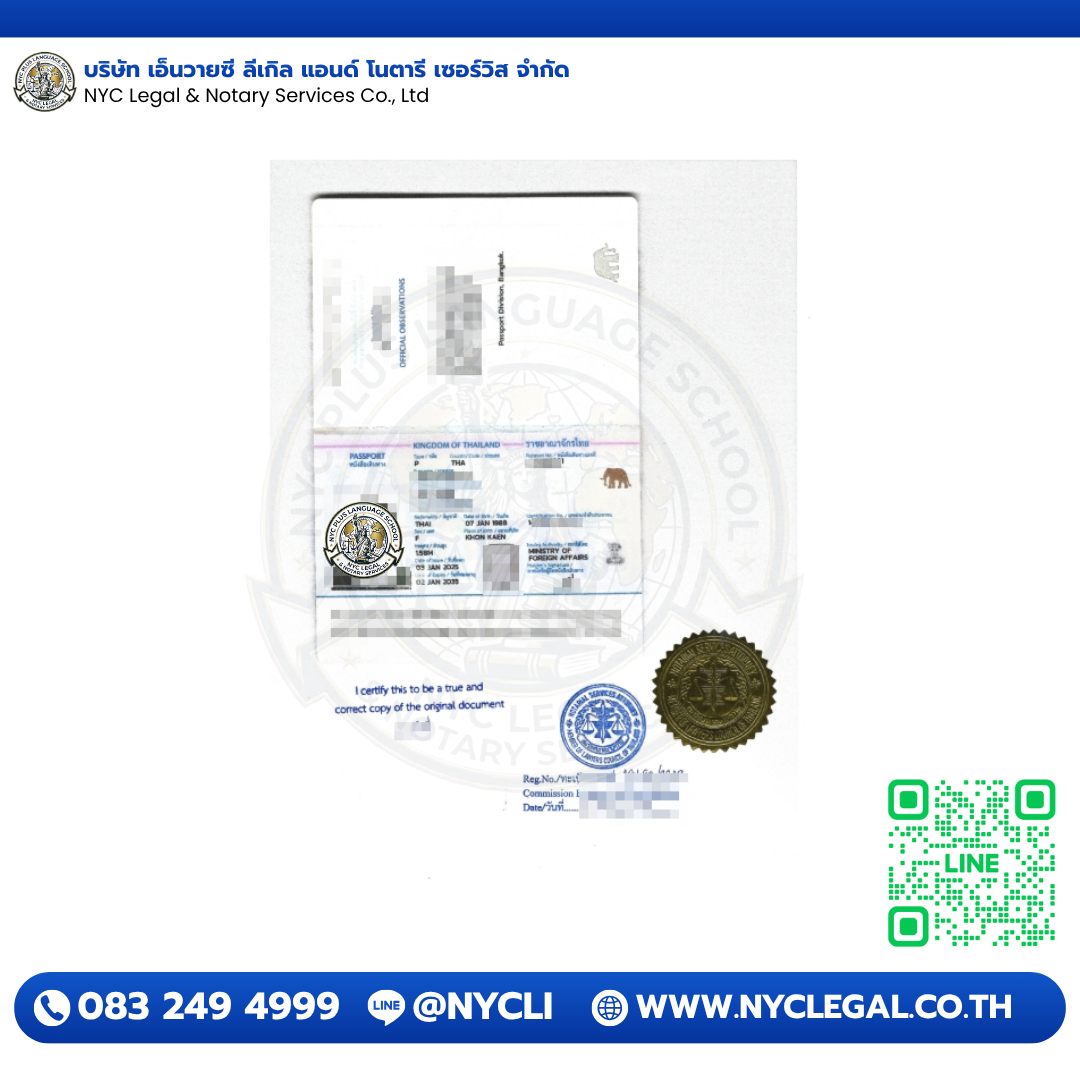
Our attorneys can issue Certified True Copies that carry weight equivalent to originals abroad — covering passports, IDs, household registrations, corporate documents, and personal records. Service-level agreements are written, not verbal. Our standard SLA covers acknowledgement within two working hours, quote within one business day, intake within two business days of approval, and delivery within the published turnaround. Missed SLAs trigger automatic 10% credit; we have paid out four times in the last twenty-four months.
Comparison of client options
Payment: bank transfer, PromptPay, credit/debit cards (Visa/Master/JCB), Stripe, Wise, and USD wire for international clients. Full Thai/English tax invoices, with 3% withholding for corporate clients. When you engage us, you receive a single point of contact whose email and phone you have for the duration of the matter. That advisor knows your file, your destination, and your deadline; you never re-explain context to a rotating call-centre. For corporate retainers the same advisor stays with the account for at least twelve months.
Add-on services worth considering
We run a pre-flight check before any MFA or embassy submission to catch the small errors that cause rejection — tear marks, ink bleed, wrong dates, missing signatures. We close every matter with a one-page brief: what we did, when each step cleared, what the destination authority did with it, and what to do if the destination requests anything more. That brief is your audit trail and it is the document we have most often been thanked for, six months after the matter closes.
Embassy and consular re-legalization
Every file is logged in our CRM with timestamped milestones. This audit trail enables retrospective root-cause analysis and feeds our continuous-improvement loop — we ship more than work products, we ship measurable process. Our liability insurance covers professional indemnity up to THB 10 million per matter, and we are happy to share the policy schedule with corporate clients who require it for their vendor onboarding. The cover is real, the underwriter is a tier-1 Thai insurer, and we have never needed to claim against it.
Lawyer-certified true copies
Our team includes Notarial Services Attorneys registered with the Lawyers Council, Ministry of Justice–listed translators, NAATI Certified translators, and dedicated embassy liaison officers. Authentication chains can fail at any link. We design our workflow so each link is verified before the next one starts: translation is QA'd before lawyer certification, lawyer certification is QA'd before MFA submission, MFA stamp is photographed before embassy submission. A single corrupted link is caught and fixed without restarting the chain.
Thailand Work Permit Services for Foreigners — service-specific notes #1
BOI Smart Visa and LTR use a fast-track channel outside the standard Work Permit, with sub-30-day approvals. We prepare and file the entire OSS application.
Thailand Work Permit Services for Foreigners — service-specific notes #2
Renewals must be filed 30 days before expiry. Lapsing forces a full re-application — we track the timeline and send tiered reminders.
Thailand Work Permit Services for Foreigners — service-specific notes #3
Employer or role changes must be notified within 15 days. We update the registry and issue the amended Work Permit on time.
Thailand Work Permit Services for Foreigners — service-specific notes #4
Required documents: company affidavit, BoI 5, latest financials, PND 30, SSO 1-10, employment contract, degree — all translated and MFA-legalized as a single package.
Thailand Work Permit Services for Foreigners — key atomic facts
Marriage to a foreign national in Thailand requires an Affidavit of Single Status from the foreign spouse's embassy, MFA-legalized translation, then registration at any district office. MFA Consular Affairs (Chaeng Wattana) processes Apostilles in 2 business days standard, 1 business day rush, with a flat THB 200 government fee per page. Foreign clients can engage us entirely remotely via Power-of-Attorney: notarize in your country, Apostille, courier to us, and we act on your behalf for the entire Thai-side chain. Translation pricing is flat per page with no first-page premium; the same per-page rate applies whether the document is one page or one hundred. Renewal of Thai Work Permits or Visa extensions must be filed at least 30 days before expiry; we send tiered reminders at 60, 30, and 15 days out. Service-Level Agreement: 2-hour acknowledgement, 1-business-day quote, 2-business-day intake, on-time delivery — with automatic 10% credit on missed SLA.